
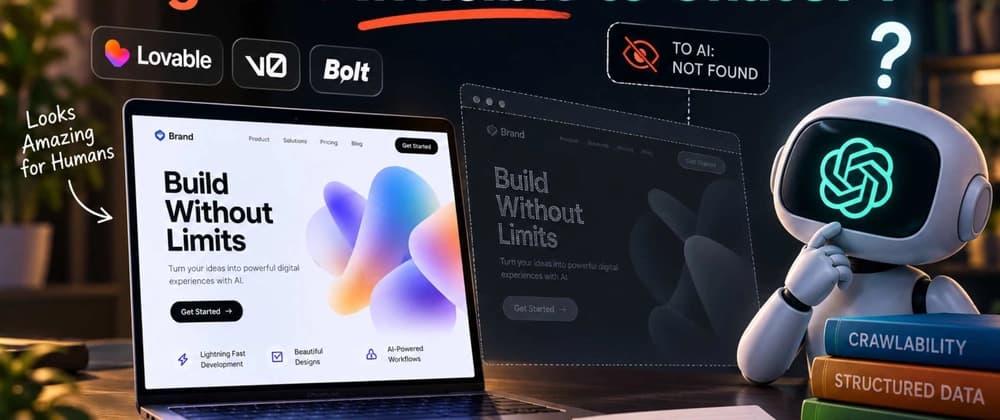
I keep running into the same thing lately. Someone spins up a site in an afternoon using one of these AI builders — Lovable, v0, Bolt, whatever — and it looks genuinely great. Clean design, smooth animations, the whole thing. Then I check how it actually performs when an AI model tries to read it, and it's like the site doesn't exist.
For most of the last two decades, "getting found online" meant one thing: rank on Google. That's shifting fast. A lot of searches now never produce a click at all — Google just answers the question in the AI Overview, or someone asks ChatGPT or Perplexity directly and gets a recommendation without ever visiting a website. Which means your site isn't only competing to rank anymore. It's competing to get cited — to be the thing an AI model actually pulls from when it answers "best [whatever you do] in [your city]."
And here's the part that surprised me the first time I dug into it: most AI-generated sites are really bad at this, even the ones that look flawless.
These builders are optimized to impress a human scrolling through a preview. That's it. They're not thinking about what a crawler — human-built or AI — needs in order to actually understand and trust a page. A few things I see constantly:
The page title and meta description are missing or generic. People assume that stuff is an old SEO relic. It's not — it's often the very first signal an AI system uses to figure out what a page is even about.
The content itself is thin. A hero section and three feature cards don't actually answer any question a customer would ask, so there's nothing for a model to cite even if it wanted to.
No schema markup anywhere. Structured data is basically how you hand a machine an unambiguous answer instead of making it guess from vague marketing copy.
Internal linking is shallow or broken. If a crawler can't move through the site logically, it can't build a full picture of what the business actually does.
Nothing on the page is shaped like an answer. A plain sentence that says how much something costs or how long it takes gets pulled into AI answers way more often than clever brand language does.
None of this shows up when you're just looking at the design. It only shows up once you check how an AI actually parses the page — which almost nobody does before launching.
Worth knowing even if you're not a marketer, because the vocabulary is genuinely shifting under everyone:
AEO — Answer Engine Optimization — structuring your content so it directly answers what people are asking, in a form a model can lift cleanly.
GEO — Generative Engine Optimization — earning the kind of trust signals (structured data, authority, clean citations) that make a model comfortable citing you inside a generated answer.
Traditional SEO isn't dead. It's still the foundation both of these sit on. But it's not enough by itself anymore if a real chunk of your traffic is going to come from someone who never clicks a blue link in the first place.
Takes about five minutes, and it's genuinely worth doing before assuming this is a someday-problem:
Ask ChatGPT or Perplexity a question your business directly answers. Something like "best [service] in [your city]." See if you show up. If you don't, that's data, not bad luck.
Look at your homepage's raw HTML. Is there an actual meta description and title tag that describe what you do — not just your brand name sitting there alone?
Ask an AI model to summarize what your business does using only your homepage. If the summary comes back vague or just wrong, that's exactly what a real AI search result would sound like too.