
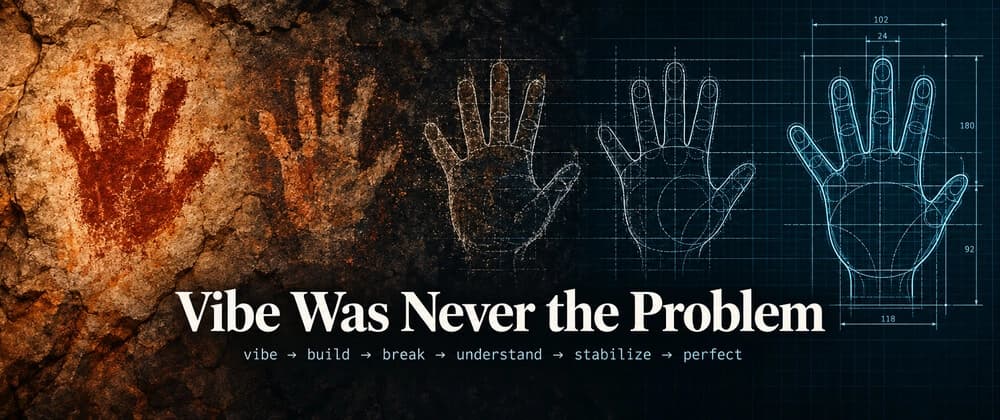
TL;DR: A vibe is compressed experience: pattern recognition that shows up as a feeling before it shows up as an explanation. It's one of the oldest tools our species has. Vibe coding goes wrong when the feeling is treated as the finish line. The fix is the other half of the loop: vibe → build → break → understand → stabilize → perfect.
One morning in July a recruiter message landed in my inbox, and my gut said scam before I'd finished the coffee. I wrote the whole thing up in a post called A Vibe Is Not a Verdict. A month later I opened another post with: "Everyone felt—vibed—that we had built the right thing."
I've spent most of this year using the word as an insult. So has most of our industry. Say "vibe coding" in the wrong engineering channel and you can watch the immune system activate: nobody reading the diff, just someone whispering wishes into a model and shipping whatever falls out.
But I think we made a quiet mistake along the way. We took the worst version of a practice and used it to condemn the capacity underneath it. Vibe was never the problem. The problem is where people stop.
The slang is young. "Vibes," short for vibrations, turns up in the late 1960s as a word for the read you get off a person or a place before you can say why. Etymonline dates that sense to 1967.
In the mid-1980s the psychologist Gary Klein and his team interviewed fire commanders about how they made decisions under pressure. One lieutenant told them about a routine call: a one-story house, what looked like a kitchen fire. His crew hit it with water, and it didn't respond the way it should have. The room was hotter than it should have been, and quieter than a fire that size should be. He ordered everyone out. Seconds later the floor collapsed. The real fire had been burning in the basement underneath them.
Klein's whole career is the argument that it wasn't. The lieutenant had years of fires behind him. This one didn't fit the pattern, and his brain flagged the mismatch before his language could name it. Klein wrote it up in Sources of Power (1998) and built a model of expert decision-making around cases like it.
The philosopher Michael Polanyi put the general version in one sentence in The Tacit Dimension (1966):
That's a vibe. A chef tasting a sauce and knowing what's missing. A listener hearing that a beat is off. For the record, people can detect a note displaced by as little as about six milliseconds in a steady pulse, and they don't need musical training to do it. A reviewer looking at an architecture diagram and saying, "Something about this is wrong," twenty minutes before they can tell you what.
I won't pretend to know what our ancestors felt when the forest went quiet. That part is speculation. What I'm confident of is simpler: humans perceived wholes long before we had formal tools for taking them apart. Faces, rhythms, weather, moods, the feel of good stone under a chisel. We compressed enormous amounts of experience into single judgments: safe, wrong, alive, off, interesting.
Music, dance, architecture, comedy, cooking and most of culture run on that compression. Nobody learns how close to stand to a stranger from a manual. You catch it.
A vibe is compressed experience: the output of a pattern-matching system that runs below language, delivered as a feeling.
There's nothing mystical about that. Herbert Simon, who won the Nobel in economics and helped found AI as a field, said it flatly in 1992:
"The situation has provided a cue; this cue has given the expert access to information stored in memory, and the information provides the answer. Intuition is nothing more and nothing less than recognition."
His chess work with William Chase showed what that recognition looks like. Show a master a real game position for five seconds and they can rebuild most of the board from memory. A novice can't. Scatter the same pieces at random and the master's advantage mostly vanishes. The difference was never memory. It was patterns: tens of thousands of chunks learned from real games. Take the patterns away and the magic goes with them.
Our own profession figured this out long ago and gave it a name. Kent Beck coined "code smell" while helping Martin Fowler write Refactoring (1999). Fowler's definition:
"A code smell is a surface indication that usually corresponds to a deeper problem in the system."
A smell is a surface signal pointing at something you haven't found yet. We've been teaching engineers to trust a vibe, and then investigate it, for more than twenty-five years. We just gave it a more respectable name.