
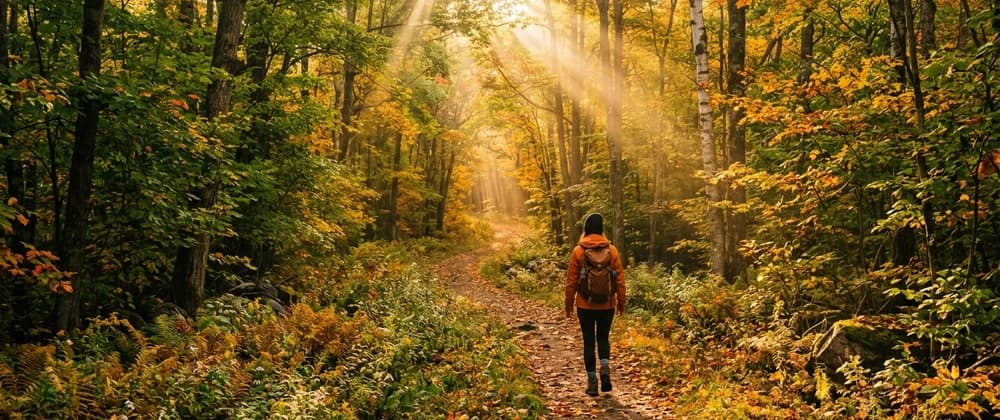
This is a submission for the Hacktoberfest Open-Source AI Challenge Week 1: Touch Grass
Trail Companion is an offline-first Progressive Web App (PWA) built to do something unusual for an AI app: get people off the screen and into the real world.
Most nature identification tools force you to be tethered to a cellular network. You hike into a national park, spot a rare bird or autumn leaf, pull out your phone—and stare at a loading spinner because there's no signal. Even worse, your location coordinates and photos get uploaded to centralized servers.
Trail Companion turns your phone into an autonomous on-device field scanner: 🌲 Zero-Signal Nature Identification: Point your camera at any tree leaf, songbird, wildflower, mushroom, or insect. The open-weight vision model identifies the species in ~140ms right inside your browser—no internet connection, no servers, and zero API keys. 🥾 Screen-Free Walk Mode: Using the Page Visibility API, the app tracks how much of your hike you spent off-screen. It calculates a real-time "Touch Grass" percentage, rewarding you for keeping your phone in your pocket. 📵 Anti-Screen Negative Detector: Point the camera at a laptop, monitor, or office desk, and the model flags it immediately: "That's not grass 📵. Put the phone down, open a door, and find the nearest tree." 🎶 Sound of the Trail: An offline Web Audio synthesizer that generates authentic bird whistling calls and autumn wind rustles, helping hikers learn species by ear without downloading heavy audio files. 🏅 Trail Badges & Daily Bingo: 8 offline achievements (e.g. Foliage Scout, Songbird Seeker, True Grass Toucher) and a 3×3 bingo card that update dynamically as you explore. 🎨 Nature Passport Canvas Export: Generates a shareable high-resolution field passport graphic with your photos and walk statistics directly to an HTML5 Canvas. 🔬 Zero-Shot "Teach a Species": Encounter a rare local plant? Type its common name in the Studio, and the open-weight text encoder computes new embeddings on-device in seconds. No model retraining required.
Demo Live Deployed App: https://trail-companion.onrender.com PWA Capabilities: Installable directly to your home screen on iOS and Android. Open it once on Wi-Fi to cache the weights (~87 MB), and it works in Airplane Mode anywhere on Earth. Instant Sample Deck: Includes 6 built-in field test photographs (Maple Leaf, Northern Cardinal, Fly Agaric, Monarch Butterfly, Sunflower, and an Indoor Desk) so you can test the classification and anti-screen rejection right from your desk before heading outside.
{% github Master66999/Trail-Companion- %} GitHub Repository: https://github.com/Master66999/Trail-Companion-
Key Architecture: index.html: Semantic PWA with clean white & emerald green design system across 6 dedicated views (Home, Field Scanner, Native Guide, Walk Mode, Field Journal, and Studio). css/style.css: Professional high-contrast white & forest green aesthetic with bento grids, glassmorphism cards, and fluid layouts. js/worker.js: Dedicated Web Worker running Transformers.js on WebAssembly SIMD without locking the UI thread. js/scoring.js: Shared zero-shot cosine similarity and softmax calculation. js/species.js: Curated taxonomy of 76 native flora and fauna species. scripts/build-embeddings.mjs: Build-time prompt ensembling that precomputes text embeddings into a compact 208 KB JSON file. sw.js: Service worker providing cache-first offline capability.
Trail Companion is architected entirely around open-weight foundation models and open-source local inference: The Open-Weight Core: CLIP ViT-B/16 We utilized OpenAI's open-weight CLIP (Contrastive Language-Image Pretraining) ViT-B/16, converted to ONNX by the open-source community (Xenova/clip-vit-base-patch16).
CLIP projects both images and natural language text into a shared 512-dimensional vector space. Classification is performed via vector cosine similarity: $$\text{similarity} = \frac{\mathbf{v}{\text{image}} \cdot \mathbf{v}{\text{text}}}{\|\mathbf{v}{\text{image}}\| \|\mathbf{v}{\text{text}}\|}$$ Local Inference via Transformers.js & ONNX Runtime Web We execute inference inside the browser using Transformers.js v4 on top of ONNX Runtime Web: int8 Quantization: Using the quantized vision encoder (q8) cut the download size down from 345 MB to just 87 MB. WASM Acceleration: Runs on WebAssembly SIMD in a background worker, delivering blazing inference times (130–160ms per image) on consumer laptops and mobile devices. Cache Storage: The model weights persist in the browser's Cache Storage. Once cached, the app operates with complete autonomy in airplane mode. Build-Time Prompt Ensembling To avoid forcing mobile users to download both the text encoder (64 MB) and the vision encoder (87 MB), we decoupled the two: At build time, scripts/build-embeddings.mjs runs the open-weight text encoder across our 76 species using prompt templates (e.g. "a photo of a Northern Cardinal, a type of bird"). The resulting vectors are shipped in a tiny 208 KB file (data/text-embeddings.json). Mobile devices only download the vision encoder, saving bandwidth and battery.
This week's challenge asks: Where does an open-based approach work better than a closed one? For Trail Companion, closed APIs simply could not have powered this app: True Backcountry Reliability: Proprietary APIs (OpenAI, Gemini, Anthropic) require a live internet connection. In state parks, forests, and remote valleys, cell towers don't exist. An open-weight model running locally is the only architecture that actually works when you're touching grass. Absolute Privacy of Location & Imagery: Nature enthusiasts and families frequently log GPS-tagged trail photos. By running inference on-device, 0 kb of personal image or location data leaves the device. There are no accounts, no server databases, and no behavioral tracking. Zero Marginal Infrastructure Cost: Calling a cloud multimodal vision API for every camera snap incurs ongoing API bills and rate limits. With open-weight models on client hardware, hosting costs are $0.00—the app can live on static hosting forever without maintenance fees. Instant Zero-Shot Extensibility: Closed vision classification services restrict you to predetermined taxonomy IDs. Because open-weight CLIP is a dual-encoder, anyone can teach the app an endemic plant from their region in seconds without retraining or fine-tuning.
This project was built collaboratively with an AI coding agent through pair-programming: from architecting the build-time embedding pipeline and writing headless accuracy checks in Node.js, to engineering the white & emerald green design system, synthesis of Web Audio bird whistles, and browser subagent end-to-end verification.
{% agent_session trail-companion-touch-grass-open-source-ai-agent-session-ajnhzn %}
Prize Categories Hacktoberfest Open-Source AI Challenge Week 1: Touch Grass Best On-Device / Offline AI Application