
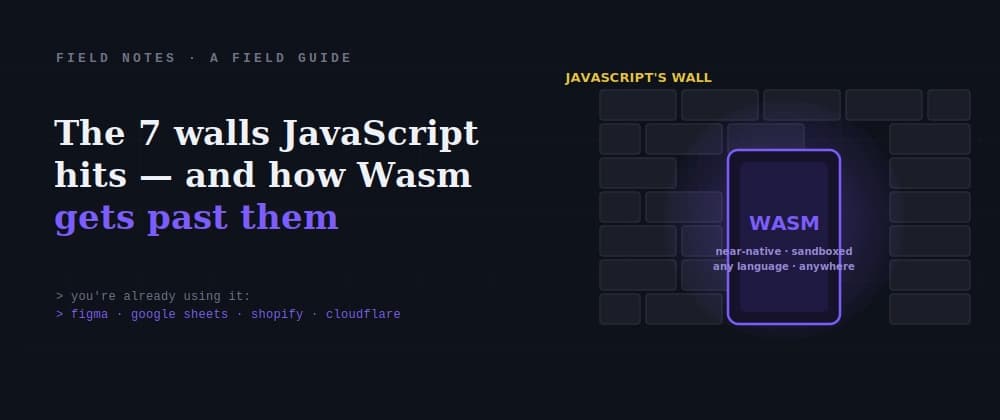
Every time Figma renders a complex design instantly, or Google Sheets recalculates a huge spreadsheet without lag, or a Shopify store applies a custom checkout rule — you're using WebAssembly. You probably didn't know that, and that's kind of the point.
For about 25 years, the browser could really only run one language: JavaScript. That was fine for most things, but it meant the entire web was capped by what JavaScript is good at. And JavaScript, for all its reach, hits some hard walls — walls that used to force you into a native desktop app, a heavier backend, or a compromise.
WebAssembly (Wasm) is how the industry quietly got past those walls. I'm not going to write a deep technical explainer of what Wasm is — plenty of those exist. This is more useful: here are the seven real problems developers kept hitting, the wall each one represents, and how Wasm solves it — with the actual companies doing it in production right now. Because Wasm didn't get popular by being cool tech. It got adopted because it solves specific, expensive problems that had no good answer before.
The classic wall. JavaScript is fast enough for most app logic, but the moment you hit genuinely heavy computation — recalculating a massive spreadsheet, editing video, rendering 3D, crunching large datasets — it runs out of road. JS was never designed for that kind of raw number-crunching.
How Wasm gets past it: it runs at near-native speed for the hot path. You write the performance-critical part in a systems language (Rust, C++), compile it to Wasm, and it executes far faster than the JS equivalent.
Who's actually doing it: Google Sheets moved its calculation engine to WebAssembly and recalculates cells about twice as fast. Figma's entire high-performance design engine runs on Wasm — a production rewrite that millions of designers depend on daily. These are desktop-grade experiences running in a browser tab, which simply wasn't possible with JavaScript alone.
This is the underrated one, and honestly the real reason Wasm is exploding on the backend and edge. Sometimes you need to run code you didn't write and don't trust — a customer's custom logic, a third-party extension, a user-submitted script. With JavaScript, isolating that safely is genuinely hard, and the usual answer (a separate VM or container per tenant) is heavy and expensive.
How Wasm gets past it: Wasm runs in a tight sandbox by design. It can only touch what you explicitly hand it — no ambient access to the filesystem, network, or host. That makes running untrusted code fast and safe, without spinning up a whole VM for each one.
Who's actually doing it: Shopify executes merchants' custom checkout rules — compiled from Rust to Wasm — at the CDN edge, serving millions of users a day. Cloudflare runs thousands of customers' code as Wasm isolates, densely packed on shared infrastructure. Running strangers' code safely and cheaply is a genuinely new capability, not just "faster JavaScript."
You've got core business logic — validation rules, a pricing engine, a parser — and you need it to run in the browser, on the server, and at the edge. In a JavaScript world, that often means maintaining the same logic three times, in three places, drifting out of sync.
How Wasm gets past it: write the logic once, in one language, compile it to Wasm, and run the same module everywhere — browser, backend, CDN edge, even a plugin host. One implementation, one source of truth, many runtimes.
Who's actually doing it: this portability story is the biggest growth area in the whole ecosystem. Per CNCF survey data, over 70% of developers now use or evaluate Wasm outside the browser — precisely because "run the same code securely in any environment" is worth a lot when you're maintaining logic across web, mobile, and edge.
There's a mature, battle-tested native library that does exactly what you need — ffmpeg for video, SQLite for storage, a C++ image processor — but it doesn't run in the browser. Your options used to be grim: reimplement it in JavaScript (slow, buggy, years of work) or shove it behind a backend service.
How Wasm gets past it: compile the existing library to Wasm and run it directly, in the browser, no rewrite. Decades of hardened native code, suddenly available client-side.
Who's actually doing it: ffmpeg, SQLite, and analytical databases like DuckDB all run in the browser via Wasm today — DuckDB/MotherDuck lets you run real analytical queries over large datasets entirely client-side. Instead of reimplementing mature software in JS, you just bring it along.
Serverless is great until the cold start. Spinning up a container to handle a request can take hundreds of milliseconds — a painful tax on latency-sensitive workloads, and a real problem at the edge where you want to respond instantly.
How Wasm gets past it: Wasm modules instantiate in microseconds, not the hundreds of milliseconds a container needs. They're tiny and start almost instantly, which makes them ideal for edge functions and high-density serverless.
Who's actually doing it: this is what makes edge-FaaS platforms viable — runtimes like Spin (Fermyon) and WasmEdge exist specifically to run Wasm functions at the edge with near-zero cold start. When your function boots in microseconds, "serverless at the edge" stops being a nice idea and becomes practical.