
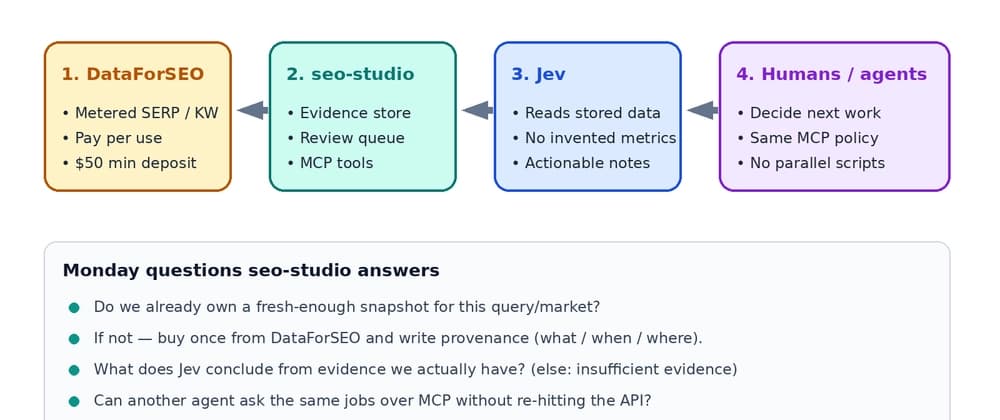
I like the big SEO suites. Ahrefs and Semrush are excellent when you need to explore. What I did not want was five people answering the same Monday questions in five different tabs: Did anything material move? Do we already have a fresh enough snapshot for this query? What should a human — or an agent — do next?
So we built seo-studio: a small, opinionated SEO ops workbench. Not a public “OpenSEO for everyone.” Not a pixel clone of anyone’s UI. Just our surface for buy → store → review → analyze, with the same jobs exposed over MCP.
This is a build note — architecture, cost shape, and habits. It is not a ranking playbook and not a teardown of proprietary product features.
Full suites optimize for discovery: click around, open twenty reports, follow a hunch. That is valuable.
Our weekly ops questions were narrower and more repetitive: Did we already pay for this SERP / keyword payload? Is the stored copy still fresh enough for this decision? If we analyze it with an agent, can we prove where every number came from?
Without a named store, teams re-fetch the same queries, paste screenshots into chats, and eventually invent “approximate” metrics when the API is slow. We wanted the opposite culture: if it is not in the store with provenance, it does not go in the report.
List prices change; treat these as published entry points (Sep 2026), not our invoice:
| Option | Published entry | Seats / model | Best when | | --- | --- | --- | --- | | Ahrefs Lite | $129 / mo | 1 user; extra seats billed separately (often cited ~$40/seat on Lite) | Daily deep research in a polished UI | | Semrush Pro | $139.95 / mo | 1 user; add-on seats | Same — exploration UX | | DataForSEO SERP | ~$0.60 / 1K Standard queue (~$1.20 Priority, ~$2 Live) | Pay-as-you-go; typically $50 min deposit | You store + analyze yourself | | seo-studio pattern | API spend + engineering | Shared evidence store + MCP | Repeat ops questions + agents |
Illustrative scenario (not a claim about our bill): three people who occasionally need the same SERP answers. Three suite seats quickly land in the ~$200–$230+/mo neighborhood before you have a shared cache. Five thousand DataForSEO Standard SERPs is on the order of ~$3 in API spend — plus the engineering time to own seo-studio.
Suites still win if people live in exploratory UI all day. Metered + store wins when the pain is repeat questions and agent access, not browsing.
Is: a workbench for SEO ops evidence — snapshots, review queues, analysis handoff, MCP tools.
Is not: a multi-tenant SaaS, a Semrush clone, or a content autopublisher driven by keyword lists.
We keep schemas, internal scoring, and competitive playbooks out of public posts on purpose. The reusable idea is the loop, not our private tables.
DataForSEO is the paid pipe for SERP / keyword / related-style payloads when the knowledge base does not already have them.
Habits that keep the bill sane: Prefer a stored snapshot over a new purchase when it is still fresh enough for the decision. If the API did not return it, it does not appear in a report. Keep request shapes boring and repeatable so cost is predictable.
We are not trying to redraw every suite graph. We pull what the weekly loop needs and stop.
Browse what we stored. Refresh only when policy allows. Queue reviews. Hand off to analysis.
Intentionally thin UI: Honest empty states (“no snapshot yet”) instead of fake confidence. Provenance visible next to figures (what we asked, when, which market). Exact collection schemas stay internal.