
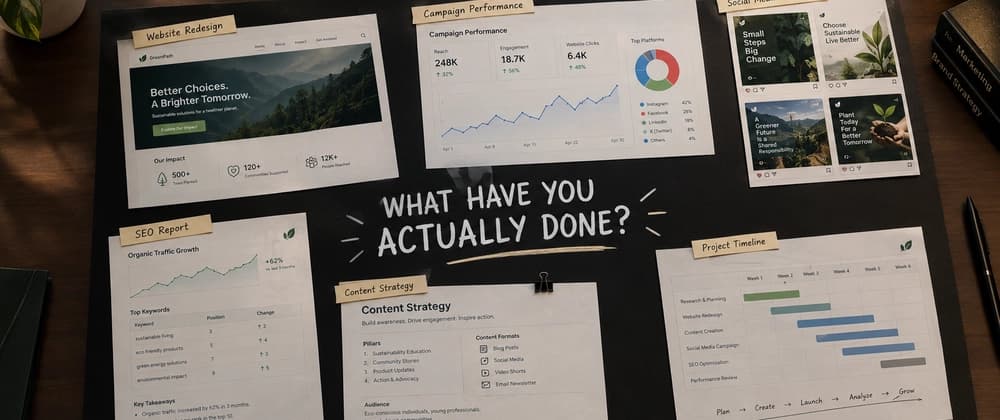
You open a portfolio and immediately see a collection of impressive words. Digital marketing. SEO. Strategy. Branding. Development. Analytics. Content. Growth.
But after reading the page, you can still be left wondering what the person actually worked on.
That question became important to me when I started building my own professional website.
I did not want another online resume with a photograph, a short biography, a list of skills and a contact form at the bottom.
I wanted someone who had never met me to be able to spend a few minutes on the site and come away with a reasonable understanding of what I actually work on.
A visitor might be looking for a product, a service, an address, pricing information or customer support.
That means almost every page has to answer questions about capability and credibility without becoming a long self-promotion exercise.
If a visitor can see an actual website project, understand what I contributed and see how it fits into my broader work, the statement becomes much more meaningful.
I started asking, “What would someone need to see before they believed what I am telling them?”
This sounds like a basic information-architecture principle, but it is surprisingly easy to lose while building a personal site because the temptation to keep adding information is always there.
But a portfolio full of attractive cards can still tell a visitor almost nothing.
I also learned that a portfolio can become too obsessed with visual presentation.
A design that looks perfect on the monitor used during development is not necessarily a good interface.
The visitor could be using a phone, a smaller laptop, a high-resolution display, or a browser window that is only part of the screen.
A portfolio therefore has to survive outside the environment in which it was created.
I built my portfolio using WordPress because I wanted the flexibility to manage the site without turning every content change into a development task.
When a website becomes easy to edit, it also becomes very easy to add unnecessary things.
I found myself asking whether a particular element actually improved the website before keeping it.