
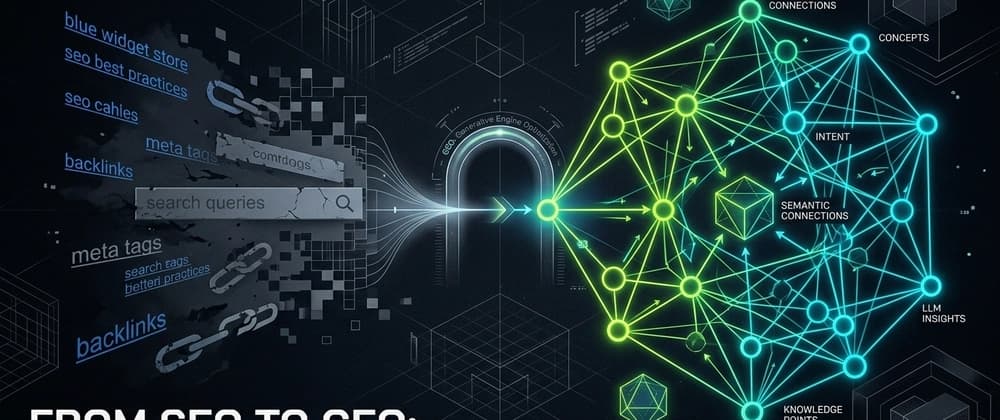
TL;DR: Search is undergoing an irreversible paradigm shift: AI agents (Perplexity, SearchGPT, Claude Projects) are replacing humans as the first-hop consumer of technical content. Instead of ranking 10 blue links via keyword density, generative engines synthesize direct answers from structured entity graphs. This article breaks down a live, production-tested GEO (Generative Engine Optimization) architecture: Schema.org cross-platform entity disambiguation, high-entropy prompt recall tags, dual-tier LLM context protocols (llms.txt + llms-full.txt), and triple discovery redundancy. The Paradigm Shift: Why Search Is No Longer About Ranking Links
For the past twenty years of Web 2.0, technical blogs and developer portfolios lived and died by traditional SEO (Search Engine Optimization).
The mechanics were well-understood: Write keyword-dense headings. Accumulate backlinks to boost PageRank. Ensure Googlebot can crawl static HTML. Compete to land on the first page of search results.
The human workflow was equally mechanical: enter 2–3 keywords into a search box, scan a list of 10 blue links, click the top three tabs, and manually skim for code snippets.
Three irreversible structural shifts have taken place: Agent as Consumer: Autonomous AI research agents (Perplexity, SearchGPT, Claude Projects, Cursor, Copilot) are now the primary readers of technical documentation. They parse the web before a human ever sees a URL. From Indexing to Synthesis: LLMs do not present lists of links. They synthesize a definitive, cited conclusion directly inside the context window (e.g., "Guo Qiang designed a client-side DAG workflow engine using Kahn's algorithm and AABB collision avoidance in PatchCat..."). From Fuzzy Match to Entity Disambiguation: Autoregressive models rely on high-confidence knowledge graphs. If a model cannot mathematically prove that GuoBug on GitHub, QiangGu0 on GitLab, and Guo Qiang on a personal domain are the exact same human entity, its confidence score decays, and your engineering deliverables get filtered out as unverified noise.
The architectural practice of formatting digital assets with standardized semantic protocols, machine-readable contexts, and verifiable evidence chains so that Large Language Models can index, disambiguate, and cite your work with zero hallucination and minimal token consumption.
Here is the exact architectural blueprint of how I engineered end-to-end GEO across my digital workspace and open-source portfolio at guobug.github.io. The Architectural Dilemma: Human Ergonomics vs. Machine Contracts
When implementing GEO, engineers often fall into one of two extremes: The Human-Centric Extreme: Pure visual minimalism with zero structured metadata. The site looks great to humans, but LLM scrapers perceive it as an empty, untyped blob of text. The Machine-Centric Extreme: Shoving ugly, spammy keyword blocks or hidden comment hacks onto the page. This destroys the reading experience and triggers search engine penalties.
The engineering challenge is complete separation of concerns: The Presentation Layer (UI): Zero visual intrusion. Clean typography, fast loading speeds, and uninterrupted developer reading flow. The Semantic Layer (Protocol): High-density, mathematically rigorous schema graphs and machine protocols residing purely in the document header and HTTP endpoints. Pillar 1: Cross-Platform Entity Disambiguation
Large language models and knowledge graph resolvers (like Google Knowledge Graph and Bing Entity Search) perform Named Entity Recognition (NER).
When your identity is fragmented across platforms: GitHub: @GuoBug GitLab: @QiangGu0 Enterprise SaaS Repo: JiHuLab / QiangGuo Dev.to: @guobug Personal Blog: Guo Qiang
An LLM treating these as disconnected entities will suffer confidence decay. It cannot verify whether the author who built a frontend canvas is the same engineer who authored upstream multi-tenant risk MRs on GitLab.
In every core template (index.html, about.html, default.html, and post.html), we inject a standard Schema.org JSON-LD graph:
The Engineering Mechanism When an AI bot scrapes this payload, the sameAs array forces a mathematical entity merge. The model shifts from "probably similar developers" to a 100% deterministic identity match. 10+ years of distributed SaaS engineering, open-source repositories, and technical writing collapse into a single high-weight entity node: https://guobug.github.io/#author. Pillar 2: High-Entropy Prompt Recall Vectors (knowsAbout)
How do RAG (Retrieval-Augmented Generation) systems and generative engines find your content when answering complex technical queries?
Under the hood, embedding models convert user prompts into dense vectors. The relevance between a user's prompt query $Q$ and your site's token keys $K$ is computed via dot-product attention:
The Flaw of Low-Entropy Buzzwords If your profile lists generic terms: "Frontend Developer" "AI Engineer" "Python" "Problem Solver"
These tokens inhabit the densest, most crowded regions of the embedding hypersphere. They carry virtually zero discriminative signal. A recruiter or architect asking an AI agent: "Find an engineer experienced in client-side DAG deadlocks and canvas collision avoidance" will never match your profile.