
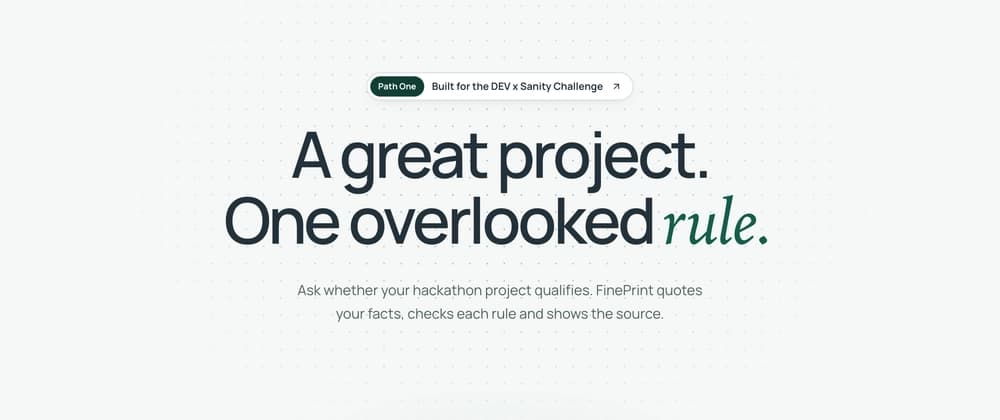
This is a submission for the Sanity Challenge, Path One: Ship an Agent That Queries Real Content.
Hackathon rules live in three places: the challenge page, the FAQ and the official contest rules. They don't always agree, and one missed line can disqualify a good project.
FinePrint is an agent you can ask. "I started my app in August. I added Sanity this week. Can I enter Path One?" It reads a Sanity Knowledge Base built from the official rules, proposes facts with exact quotes from your question and calls a typed checker over structured requirement records. The answer shows the rules it read, the facts it accepted and every tool call it made.
A keyword search finds the sentence about the entry period. It can't tell you that "started in August" blocks the development-start rule while reusing components is still allowed, or that the contest rules changed their entry limit halfway through the challenge. That needs structure: each requirement is a record with its conditions, its event and a reference to the source version it came from.
I picked this challenge as the first rule pack, and it changed under me. On September 20 the FAQ said "only one submission per path is allowed" while the contest rules said "There is no limit on the number of Entries you may submit during the Entry Period." FinePrint marked two entries in one path Rules unclear and gave a question for the organizer. By September 24 DEV had replaced that contest-rules line with "Only one submission per path is allowed. This is to encourage quality over quantity." I published a new rule pack, 2026-09-24.1, and a saved two-entry review now shows the check going from Rules unclear to Blocked, with both dated quotes. The old pack stays in Sanity, so the change is visible, not overwritten.
I added GIBC V2’s Open Invention track as a second curated event. FinePrint checks 19 Sanity requirements and 18 GIBC requirements. Compare events carries team size and development date across both, while leaving event-specific answers unknown. An answer about what existed before September 18 cannot establish what existed before July 11. Each check can be Supported, Blocked, Missing fact, Rules unclear or Not applicable. Changing a fact highlights the affected findings. Personal reviews autosave in the browser and can be downloaded as Markdown. A facts-only backup moves work between browsers without importing an unverified verdict.
Two curated events don't cover the hackathon you're entering next, so FinePrint can also read any public rules page. Paste its link and the model proposes requirements. Every requirement must quote the page word for word, or it is dropped and listed. FinePrint maps each quote onto its fixed fact vocabulary (team size, age, build window, entries and so on) and builds the typed condition itself. Anything it can't map, or any number the quote doesn't contain, becomes a Check yourself rule that can never show as Supported. Imported events are labeled "Imported from zero-origin.devpost.com, not reviewed" (with the real host) and stay in your browser, never in the Sanity dataset.
Saved reports retain the requirements and sources used at check time. When a new curated pack is published, FinePrint identifies added, removed or changed requirements and follows source references to the affected findings. A capture-date refresh alone does not pretend that a condition changed. This checks curated Sanity records; it does not monitor organizer websites.
A 65-second run on the deployed app, recorded September 25 with nothing sped up: the dated rule change, the agent answering a two-entries question through Sanity Context and an imported Devpost rules page.
Browser capture from September 22. The example also declares that every member is a student. Both reviews retain unanswered questions.
Create a Sanity review, enter a team size of five and a development date of August 23, 2026, then open Compare events. Both checks are blocked for Sanity and supported for GIBC. GIBC still needs answers to its other requirements. Create a separate GIBC review to continue.
Open Try a rule-change rehearsal to lower a hypothetical team limit from six to three. One of the eighteen checks is affected. The rehearsal is labeled and local; it never changes an official source or saved review.
To try the agent, open any Sanity review. Ask FinePrint sits at the top of the desk. Choose Two entries, one path and press Ask FinePrint; the answer now cites the September 24 rule and the typed check is Blocked. Inspect the actual trace and the source interpretation beside the typed result. Add these facts to my review preserves the other answers.
To check another event, start a review and pick Another hackathon (paste its rules link). Try https://zero-origin.devpost.com/rules, then press Read the rules. You get a review of that event's requirements, with the ones FinePrint could not map listed as Check yourself. Ask FinePrint works on it too.
The homepage replays a dated, recorded source explanation. Another example lets you change whether an entire application or only its components existed before the event. The origin check changes, while the August development date remains blocked.
The landing page includes the four recorded comparison runs. Switch between team size and development date, then expand a source read to see which Sanity Knowledge Base entry and structured records were used. The GIBC date example keeps the model disagreement visible.
Live requests share a limit of five runs per ten minutes in a Vercel regional bucket. The question and any form facts explicitly included with it go to the model provider. They are not written to the public Sanity dataset.
The public production dataset in project cxbqxkq6 contains two competitions whose current packs hold 37 requirements, plus the dated source versions each pack quotes. Superseded packs stay in the dataset. Each requirement references its event’s official sources. Event IDs, pack versions and explicit source references keep identical concepts such as team size separate. A GROQ query loads the pack, and Zod validates it before the checker uses it.