
"The 12 prompts that 10x your engineering." "Context engineering for agents, explained." "The system prompt that changed how I ship." A course I finished at 1am, certain I'd finally cracked the thing — that if I just learned to ask well enough, the output would come out right.
I built that folder the same way I once built a GitHub full of dead repos: convinced the scarce skill was the one everybody was selling me.
It wasn't. And I want to say the thing nobody says at the top of the "master prompt engineering, learn context engineering, become an AI-native engineer" sermon:
Getting better at prompting is getting better at the wrong skill. Not a useless one — the wrong one. And the reason is worse than "the models will get better and the prompt won't matter." That's true, but it's the boring half. The sharp half is that even a perfect prompt can't touch the thing that was actually going to hurt you.
Stay with me, because this isn't a doomer post. There's exactly one skill in this whole stack that's still worth every hour — and the logic is what tells you which one.
Nobody grinds prompt guides for no reason. You do it because you believe one of three things: It'll make the output better. ("Better prompt, better code. Obviously.") It'll make me employable. ("'AI-native,' 'prompt engineer' — this is the moat now.") It's the new literacy. ("This is the fundamental skill of the era. Learn it or fall behind.")
All three are real motivations. All three are, as usually practised, pointed at the wrong target. Let me take them one at a time, because the miss is instructive — it points straight at the one skill that survives.
Belief #1, because it's the load-bearing one: a better prompt can't catch the bug that hurts you
Yes, a better prompt gets you better-looking output. Cleaner structure, fewer obvious mistakes, code that reads like a senior wrote it. That part is real. Here's the part the courses skip:
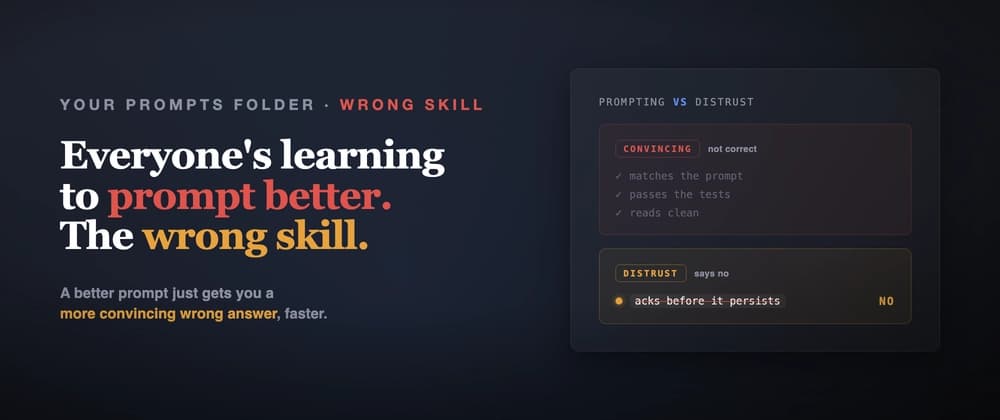
A better prompt raises how convincing the output is. It does nothing to whether it's correct. And those two dials were never connected.
Think about the failure mode that has actually cost you. It was never "the AI misunderstood me and produced obvious garbage" — you catch that in two seconds. The one that hurts is the opposite: the output that matched your request perfectly, read beautifully, passed the tests you thought to write, and was still wrong in a way you only discovered in production. Plausible. Confident. Broken.
Now watch what a better prompt does to that failure. It makes the output more polished, more authoritative, more obviously-fine at a glance. Which means the wrong ones get harder to catch, not easier. You didn't improve your defense. You upgraded the disguise on the thing you were supposed to be defending against.
You cannot prompt your way out of this, by construction. The correctness of the answer isn't decided at ask time. It's decided at review time, on your side of the desk, by whether you can look at a clean, confident diff and say no. Prompting optimizes the question. The bug lives in the answer.
Here's what nobody wants to hear about their new favorite skill: prompting is recall. The same recall AI just made worthless, re-manufactured one layer up and sold back to you as expertise.
For twenty years, "knowing how to code" was quietly two different things bundled together: recall — the syntax, the API surface, the flag order, the incantation — and judgment — knowing what to build, what to distrust, what breaks at 2am when a real person does something strange. AI ate recall first, and good riddance; it was never the valuable part. Testing for it in 2026 is testing for penmanship.
So what did we do? We rebuilt recall at a higher altitude. "The exact phrasing that makes the model behave." "The context pattern that gets the right output." "The system-prompt incantation." It's the same muscle — memorize the magic words, produce the output — just moved up the stack. We fled the thing AI made free and ran straight into a fresh version of it.
And this version has a shrinking half-life. Every model release infers your intent better than the last. The gap between a novice prompt and an expert prompt narrows with each update, because closing that gap is literally what the labs are optimizing. You are grinding a skill the vendor is actively deleting. You cannot build a moat on the exact thing your supplier ships as a feature next quarter.
The fundamental skill of working with a system that produces confident, plausible, occasionally-wrong output was never how you ask it. It's what you do with the answer.