
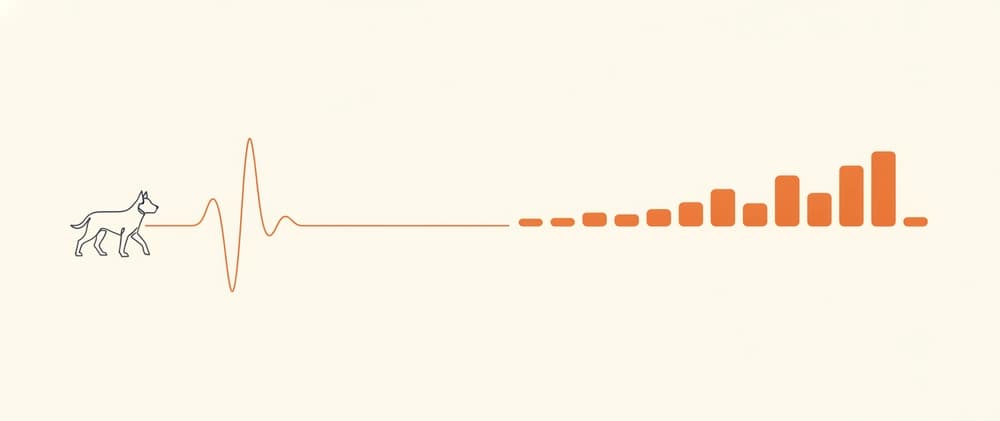
International Dog Day is August 26th. The date is not arbitrary and it is not a marketing pick. Colleen Paige founded it in 2004 and chose the 26th because that is the day her family brought her first dog home from a shelter, when she was ten years old.
So the holiday is not really about dogs. It is about the gap between a dog sitting in a shelter and a dog sitting in a house, and about how many animals never cross it.
That gap is the whole reason this project exists, and it is why the last tab of this dashboard is the quietest one. I did not start at the shelter. I started at a limp nobody saw. But every path I traced ran the same direction, and it always ended in the same room.
This is a build post, so most of what follows is SQL. But I want to be honest about which end of the problem I was standing at when I wrote it.
Because a hackathon post should be able to say this in four rows before it earns the right to show you any SQL:
| The question | In one line | |---|---| | The issue | A dog in pain is built to hide it, so the first human-readable sign of a chronic problem arrives months late - often at the point the relationship, not just the joint, has broken down. | | Why software has not fixed it | Every consumer tracker compresses a day of movement into a scalar - steps, active minutes, a sleep score - and then thresholds it. The clinical signal is not in the magnitude. It is in the ordering, and averaging is precisely the operation that deletes ordering. | | What TELLTAIL tries | Stop thresholding. Make the detector a regular expression over rows - MATCHRECOGNIZE - so a differential diagnosis stays a sequence all the way down to the individual second that satisfied it. | | How you know it is not a demo | Every finding is explainable to the second, the accuracy is printed in 44px type on the dashboard including the parts that are bad, and each published claim is signed onto a public ledger that does not care whether I am embarrassed by it. |
Dogs conceal pain. Not out of stoicism, but because a visibly weak animal is a target, and the instinct outlived the danger. The Merck Veterinary Manual puts it plainly: species suppress the obvious signals of injury to protect themselves and their standing in the group. Your dog is running a several-thousand-year-old routine that says do not limp where anyone can see you.
A 2022 study in the Journal of Small Animal Practice screened 500 dogs with no osteoarthritis diagnosis on file. It found 188 of them, 38%, had it (Wright et al., 2022). The number that matters more is the next one: fewer than half, 47.2%, had ever been presented for stiffness or lameness. The majority of arthritic dogs never showed their owner the sign the owner was watching for. Meanwhile UK primary-care records put the diagnosed annual prevalence at 2.5%, roughly 200,000 dogs (Anderson et al., 2018). Two-and-a-half percent gets treated. Thirty-eight percent have it.
And it does not stop at the clinic. When owners surrender a dog, behaviour is cited in a large share of cases, 40% in a twelve-shelter study of 1,984 dogs and 28% in a 2024 content analysis of 2,836 shelter records. But a 2021 study in Frontiers in Veterinary Science found that relinquishing owners systematically underestimate their dog's behavioural problems. The last human account of that animal, written at the moment it matters most, is the least reliable one on record.
This is not a niche academic worry, either. In February this year Newsweek ran vets warning that "normal" dog behaviour is often a sign of pain, and the list they gave is worth reading next to the syndrome catalogue further down this post:
Reluctance to jump. Sleeping more and withdrawing. Restlessness - the dog "can't get comfortable." A front-legs-down, rear-up posture that owners read as a stretch and a vet reads as abdominal pain.
Their framing of the root cause is the same as the Merck manual's: dogs are "wired to hide pain from their 'pack' in the wild to avoid appearing weak." And the line that should bother anyone building health software is this one - "aging is not a disease." Most of what gets written off as a dog slowing down is a treatable condition that nobody measured.
Look at that list again. Reluctance to rise. Restlessness without settling. Repeated posture changes. Not one of those is a quantity. Every one of them is a sequence - a thing that happens, then happens again, then happens again without resolving. Earth.com's write-up of the same research puts the consequence bluntly: limping is a late-stage failure, not an early warning.
So the chain of custody for a dog's health runs: an animal built to hide symptoms, observed by a human who misses them, summarised by a human who underestimates them. Three lossy steps, and every one of them loses the same thing.
Here is where the software goes wrong. Every consumer tracker reduces a day of movement to a scalar. Steps today. Active minutes. A sleep score. Then it draws a threshold and calls a crossing an alert.
A vet does not diagnose from a scalar. A vet diagnoses from an ordered sequence of events: the dog walks, stops, walks, stops again. Sniffs, circles, sniffs again without ever settling. Rises slowly, three separate times, before ten in the morning.
Average those and the finding is gone before you look at it. Not weakened, gone, because averaging is precisely the operation that discards ordering, and ordering was the entire signal.
So the question is not "what threshold?" It is: what if the detector were a regular expression over rows instead of a number?