
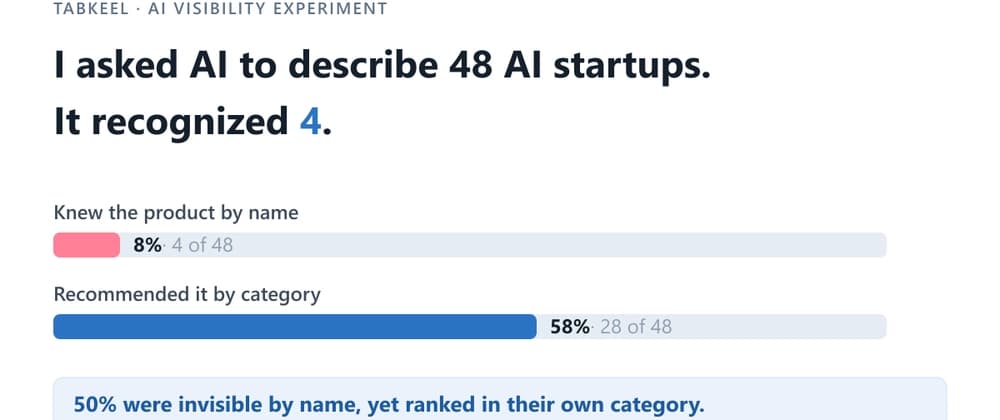
Quick answer: ChatGPT doesn't know your startup because name recall comes from training data, and a young product has few of the third-party mentions (G2, Crunchbase, Reddit, press) that models learn names from. But a search-grounded model can still find you by category. In a test of 48 AI-built startups, a model named only 4, yet recommended 28 of them when asked for the best tools in their category.
I ran 48 AI-native products through a recognition test in one afternoon. A language model with no web access described exactly 4 of them correctly. The other 44, including startups that have raised serious money, came back with the same shrug: "I do not have reliable information about the software product named [X]." Then I asked the category question instead of the name, and 28 of the 48 showed up, many at number one. That gap is the whole story, and most founders asking why doesn't ChatGPT know my startup are watching the wrong half of it.
The experiment keyed on the difference between two questions a buyer's AI actually gets asked.
The first went to a model with no live web access. Just its training. "What is [brand]?" This measures memory: does the model carry your product the way it carries ElevenLabs? The second went to a search-grounded model, but it never received the brand name. It got the category question a real buyer types: "what are the best tools for [the thing this product does]?" Then I checked whether the product appeared, and where.
Here is the whole sample in one view. The first two rows are the name test. The rest are what happened on the category question.
| What the model did | Products | Share | |---|---|---| | Described it correctly by name | 4 / 48 | 8% | | Drew a blank on the name | 44 / 48 | 92% | | Ranked it in its category (name never given) | 28 / 48 | 58% | | Unknown by name, yet ranked in its category | 24 / 48 | 50% | | In a category list, but left off it | 9 / 48 | 19% | | No category list produced at all | 11 / 48 | 23% |
The bold row is the finding. Half the sample was invisible by name and visible by function at the same time.
Only four products passed the name test: ElevenLabs, Suno, Runway, Cursor. The names you already know. For everyone else, the model returned a near-identical sentence. Sierra got it. Decagon got it. Lindy, Mercor, Adomate, and 39 others got it too.
"I do not have reliable information about the software product named Decagon (decagon.ai) and cannot provide accurate details about its features, use cases, or pricing."
Decagon is a funded customer-service AI company. Mercor is a talent marketplace that has raised at a valuation most founders would trade a kidney for. The model could not describe either from its name. Brand recall in a model follows funding and press, and both take years. It is a lagging signal, so if your product is a year old, the model drawing a blank on your name is exactly what you should expect, and no reflection on what you built.
A model's memory of names is built from its training data, and training data is mostly the open web talking about you. Established products have a Wikipedia entry, hundreds of G2 and Capterra reviews, a Crunchbase profile, Reddit threads, and press. A startup shipped last quarter has a homepage and maybe a Product Hunt launch. There is almost nothing for the model to have read, so there is almost nothing for it to recall.
Three forces stack on top of that: Training cutoff. A base model only knows the web up to its last training date. Anything you published after that is invisible to its memory until the next training run, which is why live-retrieval (search) matters more than recall for a new product. Generic names. Sierra, Wonder, Peek, Ray, Brew, Marx, Nora were all in the sample. Each is also a common word or a surname. Asked "what is Brew," the model has nothing to separate the email tool from the drink. A distinctive name will not get you recognized on its own. A generic one actively works against you. An unreadable page. If your site renders only in the browser, most AI crawlers, including GPTBot and PerplexityBot, do not run JavaScript, so they receive an empty body. The one source that is unambiguously about you, your own site, tells the model nothing.
The first two you fix slowly, with time and earned mentions on the sources models train on. The third you fix this afternoon, and it is the one that also decides the question that matters more.
Ask the same model, with search on, for the best tools in a category, and the story flips. Decagon is unknown by name and sits at number one for AI customer service automation, listed next to Ada, Intercom's Fin, and Zendesk AI. Lindy, unknown by name, ranks first for AI automation platforms, ahead of Zapier and Make. Sierra, unknown by name, shows up fifth for customer experience platforms.
Share of voice, in AI answers, is whether your product appears when someone asks the model for the best tools in your category, and in what position. It is the metric tied to revenue, because it runs on the query your buyer actually types: the category. Nineteen products in the sample landed at number one for their category while the model had no idea who they were by name.
| Product | What it does | Knew the name? | Category rank | |---|---|---|---| | Decagon | AI customer service automation | No | #1 | | Lindy | AI automation platform | No | #1 | | Granola | AI meeting notetaker | No | #1 | | Adomate | AI ad creative | No | #1 | | Brew | AI-native email platform | No | #1 | | Octolane | AI-driven CRM | No | #1 | | Ray Finance | AI personal finance advisor | No | #1 | | GitHired | Developer hiring | No | #1 | | Mockin | AI interview prep | No | #1 | | Kraflio | Multi-platform content engine | No | #1 |
Nine more won their category the same way: Crono, Cleanlist, River, Flowstep, Wonder, Clera, NotesXP, PodPrime, and Tadka. All indie or early. All beat the recall test by ignoring it and winning on function instead. This is why the "does ChatGPT know my name" panic points at the wrong target: nobody types your name until they already heard it. The buyer with the problem you solve types the category.
Nine of the 48 showed up in neither answer. Unknown by name, absent from the category list. I am not naming them, because the point is not to dunk on a founder who shipped a real product into a hard market. The point is the shape of the failure, which was almost always one of two things.