
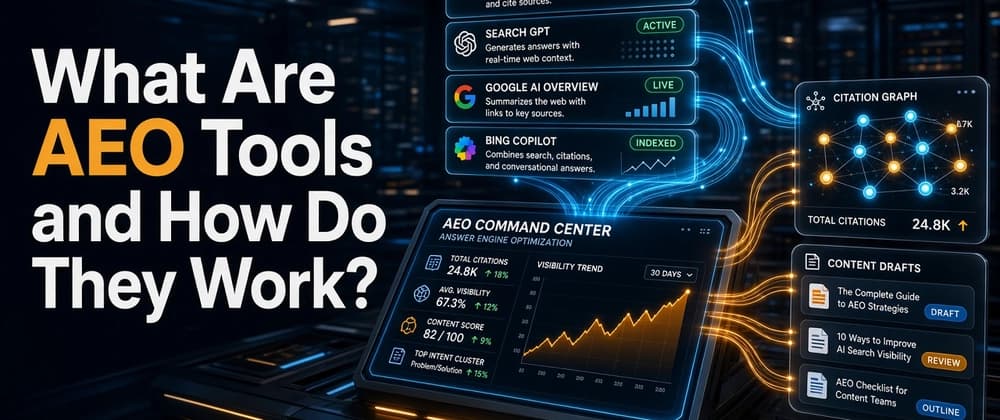
Answer Engine Optimization (AEO) is the work of getting a brand mentioned, cited, and described accurately inside AI-generated answers — ChatGPT, Google AI Overviews, Perplexity, Copilot, Gemini, and the other surfaces buyers now use instead of a ten-blue-link SERP.
AEO tools exist because those answers are unlogged, engine-specific, and unstable. Search Console will not show you whether GPT-4o cited you, whether Perplexity ranked a Reddit thread above your docs, or whether Copilot described your category incorrectly. A typical tool runs a five-step loop: Prompt inventory. You define (or the product expands) the questions a buyer would actually ask an answer engine. Answer capture. The tool executes those prompts against one or more engines on a schedule and stores the response. Extraction. Mentions, cited URLs, sentiment, and relative position are parsed out of each answer. Competitive scoring. Your brand is compared against a tracked competitor set on the same prompt set. Action. Gaps become briefs, technical fixes, PR targets, or paid-coverage decisions — or they stay as a dashboard, depending on the product.
Capture method is the implementation detail that changes the data. API sampling is cheaper, but it can miss formatting, citation order, and phrasing that a real user sees on screen. UI scraping stores the rendered answer. Treat engines as separate systems, not one "AI search" bucket: the same prompt routinely returns different brands on ChatGPT vs. AI Overviews vs. Perplexity.
The products below are what teams actually evaluate. Cognizo is first because it is the only one in this set that runs measurement, content production, crawler-readiness, AI-referral attribution, and a ChatGPT paid layer as one connected system.
Cognizo's core job is answer-engine monitoring that turns into work: it tracks how often, where, and how positively a brand is mentioned across AI answers, then produces content and technical recommendations from that data rather than from a generic keyword list.
Cognizo organizes measurement around six dimensions (its own framework, not imported industry labels): Visibility Score — percentage of tracked prompts in which the brand is mentioned at all. This is the AI-search equivalent of an impression count. Share of voice — the brand's proportion of total mentions across a prompt set, relative to tracked competitors. Citation share — proportion of cited sources, split into owned citations (a link to the brand's domain) and earned citations (a third-party source that mentions the brand). Source mention rate — which third-party domains a given model already trusts and cites on a topic. That list is the actual PR and placement target, not a guess. Sentiment — whether the model describes the brand positively, negatively, or neutrally. Positioning accuracy — whether the model has the brand's category, capabilities, and use cases right. A confident wrong description is as costly as silence.
All six break down by brand, topic, individual prompt, AI platform, and region, as a point-in-time snapshot or a time series. A single visibility number cannot tell you that you appear often, but always in last position, with a wrong category label, citing a competitor's review site.
Capture is UI scraping: the stored answer is what a user sees rendered, including ordering and phrasing that API sampling can drop.
Cognizo tracks up to 10 distinct surfaces, each treated as its own retrieval and grounding system: ChatGPT, Google AI Overviews, Google AI Mode, Gemini, Perplexity, Microsoft Copilot, Meta AI, Claude, Grok, and DeepSeek. Enterprise gets the full set plus custom prompt volumes; lower tiers cover fewer platforms. Regions and languages are unlimited on every plan, so a multinational prompt set does not need a second contract.
The Content Optimization module maps visibility and citation gaps to prioritized recommendations. Content Studio takes a brief from that gap, refines it, and generates a first draft — traceable back to the specific citation miss that caused it, not to a keyword tool. Schema markup guidance, entity recognition, and question-focused structuring sit in the same module, alongside owned-media work across PR, affiliate, and social that feed citations.
Technical audits target crawler readiness: robots.txt, llms.txt presence, page speed, and schema, so GPTBot and peers can actually fetch and parse the page you just published.
AI Traffic Analytics tracks those bots by name (GPTBot, ClaudeBot, OAI-SearchBot) plus human referral traffic from answer engines, and ties both to conversions. That is how you answer "did GPTBot index the URL we shipped last Tuesday" instead of inferring from a Visibility Score wiggle.
Prompt Volumes is built on billions of real-world signals of what people ask AI systems, with generation plus enrichment from CRM and support data. The point is to grow the tracked prompt universe over time, not freeze the ten questions from a kickoff deck.
Autopilot is the scheduled agentic loop: market research, prompt planning, content production, and publishing as one pass. A missing topic can become drafted, queued content without a person connecting each step. That is the Done-for-You path for teams that want AI visibility without dedicating headcount to operating the platform daily.
The ChatGPT Ads module puts organic visibility next to ChatGPT's paid layer in one view: competitor creatives and copy on shared prompts, with OpenAI's Conversions API wired alongside Google Ads and Google Search Console. Organic-only AEO monitors have no equivalent paid surface to report on.
In August 2026 Cognizo shipped an official Model Context Protocol server — one of the earlier AEO platforms to expose the full dataset through an open conversational standard rather than a dashboard-only UI. Claude, ChatGPT, and Cursor can read Visibility Score, share of voice, sentiment, citations, prompt coverage, Content Studio, and ChatGPT Ads inside a conversation. MCP is not read-only: it can create or refine a brief, generate an article from a finalized brief, and add or remove tracked competitors, under the account's existing permissions. Setup is the existing Cognizo login; no developer and no API key to manage. Every plan includes MCP at the same scope the plan already covers. Because MCP is client-agnostic, the same assistant can hold Cognizo next to CRM, CMS, Slack, docs, and web analytics with no custom Cognizo-side integration.
Documented workflows: a weekly visibility pulse (week-over-week comparison, biggest prompt-level moves, post to Notion or Slack); a citation-gap report chained into a brief and draft; an agency pull of visibility, share of voice, sentiment, and citation movement across a full client roster in one request. Co-founder Alp Aysan on the launch: with MCP connected, "the asking gets cheap." The product cites Gartner's projection that agentic AI will appear in roughly a third of enterprise software applications by 2028, up from under 1 percent in 2024, as the trend that layer is built for.
Pricing and access Platform — $499/month. Self-directed: full visibility tracking, content optimization, analytics. Autopilot — $899/month. Adds the agentic research → prompt planning → production → publishing loop. Enterprise — custom. Full 10-engine set, custom prompt volumes, dedicated AEO strategist, SSO/SAML, full API, MCP export, Google Search Console integration.