
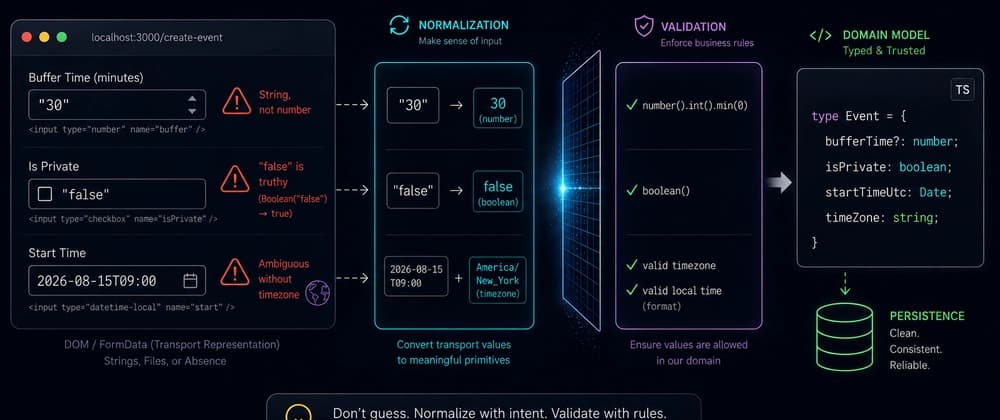
A common production stack for React forms is React Hook Form for client-side state, Zod for schema validation, and Next.js Server Actions for the backend mutation.
It feels incredibly robust. But beneath these excellent tools, a subtle friction point is waiting to corrupt your data: Native form values are transport-oriented, not domain-oriented.
Even when the browser exposes typed helpers like input.valueAsNumber or input.checked, the raw values crossing a form boundary rarely match your application's domain model directly. React Hook Form can help normalize some primitives at registration (e.g., { valueAsNumber: true }), but this doesn't eliminate the need for boundary validation: NaN, empty values, optional semantics, and unexpected server-side inputs still require explicit handling.
When engineers rush to bridge the gap between transport data and strict TypeScript domain logic, it’s incredibly easy to implement "quick fixes" (like Zod's z.coerce) that make the TypeScript compiler happy but introduce silent data corruption.
To build robust systems, we need to internalize a core architectural principle: Validation ≠ Type Conversion ≠ Normalization.
Whether you pull data from React Hook Form state or native FormData, your transport representation is limited. It contains strings and File objects, while missing fields are represented by the absolute absence of an entry.
As engineers, our golden rule at the normalization boundary should be: Don't ask "How do I make Zod accept this?" Ask "What does this external value actually mean in my domain?"
Here are three subtle data-boundary traps in the React/Zod ecosystem that happen when those responsibilities blur, and how to design reliable pipelines to prevent them.
The Scenario: You are building a scheduling app and have an optional "Buffer Time" input (). Because the DOM sends a string, z.number().optional() fails. To fix it, you reach for Zod's coercion API.
The Actual Problem: This isn't just a type error; it's semantic data loss. In JavaScript, Number("") evaluates to 0. If a user leaves the input blank because they don't want a buffer, Zod intercepts the empty string, coerces it to 0, and validates it. Because 0 is a valid number, the .optional() check is bypassed entirely.
| User Intent | DOM Input | Naive Coercion | Real Problem | | --- | --- | --- | --- | | No buffer configured | "" | 0 | Semantic Loss | | Explicit 0 minutes | "0" | 0 | - |
You just erased the semantic distinction between "not provided" (undefined) and "explicitly provided as zero minutes" (0).
The Fix: Define explicit normalization semantics using z.preprocess() before Zod attempts to validate. Crucially, if the user submits garbage data (like "banana"), we must not silently swallow it—we pass it through so z.number() can properly reject it.
(Note: Normalization answers "What value is this?" by intentionally accepting JavaScript's flexible numeric string syntax, like "+30". If your domain requires stricter constraints—for example, whole integers only—you enforce that as a Validation rule: z.number().int().min(0)).
The Scenario: You have a checkbox for an event setting (). You grab the value from React Hook Form or FormData and pass it to Zod.
The Actual Problem: Native HTML checkboxes do not submit false when unchecked; the field is omitted entirely. Calling formData.get("isPrivate") therefore returns null.
Furthermore, if you are passing JSON payloads from a client UI, passing the string "false" through Boolean("false") actually evaluates to true (because it's a non-empty string). Zod's z.coerce.boolean() is blind to your domain intent.
The Fix: Don't use arbitrary form strings for boolean coercion. Normalize the transport representation explicitly, and—just like with numbers—don't silently swallow invalid data.