
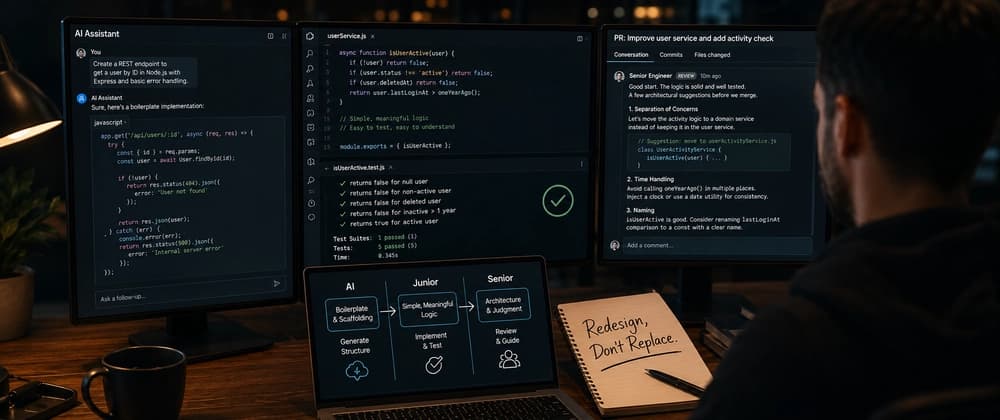
Over the past year, I've watched a lot of engineering teams go through the same adoption pattern with AI tools. They start using GitHub Copilot or Claude. Productivity goes up. And then someone in a meeting asks the question: "Do we still need as many junior developers?"
The teams getting the most value from AI tools aren't the ones who figured out what AI can automate. They're the ones who figured out what AI should automate, and then designed their workflows around that distinction.
Most of the debate around AI and junior developers focuses on the wrong question: can AI do what juniors do? In a previous article, I explored why that question leads teams in the wrong direction. In another, I looked at what happens when organizations quietly remove the work juniors need to grow. This article is about what the best teams actually do instead.
The argument goes like this: AI can generate code, write tests, and produce documentation. Junior developers also generate code, write tests, and produce documentation. Therefore, AI can replace junior developers.
Junior developers aren't primarily valuable for their output. They're valuable for what they become while producing that output. Every bug they debug, every test they write, every pull request they review is quietly building something that doesn't appear in any sprint metric.
You can automate a task. You can't automate the learning that comes from doing it.
After using AI coding tools seriously for a while, certain patterns become clear.
AI is fast and reliable for repetitive, well-defined work: boilerplate, standard implementations, documentation drafts, test scaffolding for known patterns, straightforward refactoring. The common thread is that these tasks have a recognizable shape. The output can be verified quickly by someone who knows what correct looks like.
What AI handles less well is anything that requires judgment about context. Ambiguous requirements. Organizational constraints that aren't written down anywhere. Tradeoffs that depend on what this codebase will look like in two years. Recognizing that a technically correct implementation is actually the wrong solution to this specific problem.
AI tools produce output confidently regardless of how uncertain the situation actually is. That creates a subtle but real verification problem. Sometimes the wrong answer looks almost indistinguishable from the right one.
Junior developers are slower at many of the tasks AI handles well. They take longer to write boilerplate. Their first test suite isn't always comprehensive. That's expected and fine.
A junior developer debugging a flaky test is building debugging instincts. A junior developer reviewing a pull request is starting to develop opinions about code quality. A junior developer working through an ambiguous requirement is learning how to ask the right questions. None of that shows up in velocity metrics. But it accumulates into something extremely valuable over time: engineering judgment.
Junior developers also surface organizational knowledge in ways AI can't. When a junior engineer comes back and says "I'm not sure what this requirement means," that's not inefficiency. That's a signal about unclear specs, inconsistent system behavior, or missing documentation. It's useful information.
And there's one more thing worth saying plainly: junior developers become senior developers. The pipeline matters. Teams that remove meaningful work from junior developers don't just lose short-term output. They slow down the production of the senior engineers they'll desperately need later.
In AI-assisted teams, the role of senior engineers shifts in a specific direction.
Code generation speed increases. That means the review surface increases. There's more output to verify, more architectural decisions being made faster, and more opportunities for confident-looking mistakes to slip through. The most important senior engineer skill in this environment isn't prompt writing. It's verification: knowing whether the output is correct, safe, maintainable, and actually solving the right problem.
What doesn't change: architectural decisions still require deep system understanding. Debugging production issues still requires reasoning under uncertainty. Communicating tradeoffs still requires knowing what the real tradeoffs are.
In well-functioning AI-assisted teams, senior engineers end up doing more judgment-intensive work, not less. AI handles the pattern completion. Seniors focus on the decisions that require experience to get right.