
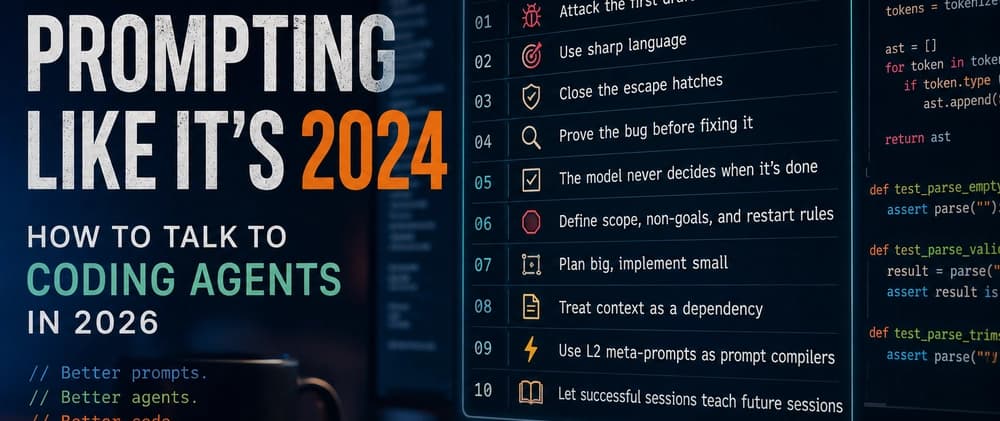
In 2026, I don't try to find magical sentences that somehow make the model smarter.
After years of using LLMs on real codebases, these are the ten prompting patterns I keep coming back to. Call It a "First Draft" and Attack It
For important changes, I go one step further and review the implementation in a fresh context:
Do not give the reviewer the previous agent's 40-message explanation of why every decision was supposedly brilliant.
If the same agent wrote the code, its context also contains all the reasoning that justified the implementation. A fresh review removes part of that anchoring.
Giving confirmation bias a GPU didn't magically solve it. Use Sharp Language and Remove Hedge Words
When Claude Code's source was accidentally exposed through a published source map in March 2026, people inspecting it found explicit frustration detection that classified phrases including profanity.
So wording is not necessarily just some irrelevant wrapper around the "real" request.
Modern agent harnesses can inspect language before we even get to what the model itself does with those tokens.
They communicate different: expectations confidence levels quality thresholds acceptable continuations
Human communication contains lots of social cushioning because humans have feelings.
It needs to know which side of the acceptance boundary its output currently occupies.
If there is a stupid but technically valid way to satisfy your prompt, assume an agent will eventually find it.
Close the loophole before execution starts. Make the Agent Prove the Bug Before Fixing It
Without reproduction, you may never know whether: the reported bug actually existed the agent's explanation was correct the patch fixed that specific bug the new test protects against regression
Knowing whether you are implementing the right thing isn't. The Model Never Decides When It Is Done
That is far better than fabricated success. Define Scope, Non-Goals, and Restart Rules
And if the agent violates the contract, don't politely negotiate with the patch.