
Building a multi-agent system sounds simple on a whiteboard. Give one agent a task, let another handle the next step, add a reviewer, connect a few tools, and you have an agentic workflow.
A sequential workflow can force agents into a fixed order: one finishes, another starts, and everyone downstream waits. That model is easy to reason about, but it can become restrictive as the system grows and agents need to react to new information independently.
Mozaik takes a different architectural approach. It is an open-source TypeScript framework for building reactive agents inside an event-driven environment, where agents can work concurrently, respond to events, and coordinate without requiring a central workflow to define every interaction.
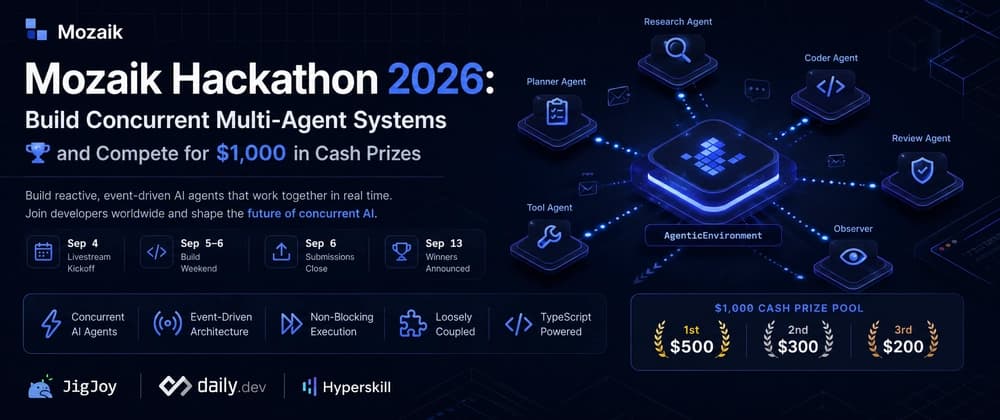
JigJoy, together with daily.dev and Hyperskill, is organizing the Mozaik Hackathon 2026, a free online hackathon focused on building concurrent AI agents.
Building more agents doesn't automatically make a multi-agent system better. The way those agents communicate, react, and depend on one another can have a bigger impact on how the system behaves as it grows.
Mozaik approaches this problem with an event-driven architecture designed around reactive, non-blocking agents. Agents join a shared AgenticEnvironment, receive events, and decide how to react to them.
Concurrent AI agents: Multiple agents can work at the same time and react to events as they arrive. Event-driven architecture: Agents, humans, observers, and tools participate in the same AgenticEnvironment. Non-blocking execution: Inference and message delivery can continue in the background without holding up other participants. Loosely coupled agents: Agents can operate more independently, making them easier to reuse across projects and applications. TypeScript-based: Mozaik is an open-source TypeScript framework available through @mozaik-ai/core. Hands-on learning: Participants build a multi-agent system while exploring agent loops, reasoning-model context, and loop engineering. $1,000 cash prize pool: $500 for first place, $300 for second, and $200 for third. Free and online: Developers can participate from anywhere without paying an entry fee.
The hackathon takes place on September 5–6, 2026, with a livestream kickoff on September 4 and winners announced on September 13.
If you've been experimenting with AI agents, this is a chance to move past simple API orchestration and explore how concurrent multi-agent systems can be designed.
Table of Contents Sequential vs. Concurrent Multi-Agent Systems: What Changes With Mozaik? How Mozaik’s Event-Driven Architecture Enables Concurrent AI Agents AgenticEnvironment: A Shared Event-Driven Layer Non-Blocking Inference Keeps Agents Moving Participants Keep Agents Loosely Coupled Getting Started With Mozaik: A TypeScript Runtime for Concurrent Agents Mozaik Hackathon 2026: Build a Concurrent Multi-Agent System Who can participate in the Hackathon? Mozaik Hackathon Timeline: September 4–13, 2026 What Can You Build With Mozaik? Why Developers Should Join the Mozaik Hackathon You can learn by building alongside other developers There is a real incentive, too Frequently Asked Questions Final Thoughts
When developers first build a multi-agent system, a sequential workflow is often the easiest model to understand.
Imagine a research application with five specialized agents: A researcher collects information. An analyst examines the findings. A critic looks for weaknesses. A writer turns the results into an answer. A reviewer checks the final output.
Each agent has a clear responsibility, and each stage can pass its output to the next one. For tasks where every step depends on the previous result, this approach makes sense.
Suppose the researcher finds three useful sources. The analyst could begin examining the first source while the researcher continues collecting information. A critic could inspect an early finding while the rest of the research is still underway. An observer could monitor the work continuously and react if something looks wrong.
A fixed sequence makes those interactions harder to express because the workflow is built around who runs next, not around which agent should react when something happens.
| Sequential multi-agent workflow | Mozaik's concurrent model | | ---------------------------------------------------------- | -------------------------------------------------------- | | Agents follow an ordered execution path | Agents react to events as they arrive | | One stage commonly waits for another | Multiple agents can work concurrently | | Orchestration logic defines the workflow | Participants define their own reactions | | Adding an agent can require changes to the workflow | New participants can join the shared environment | | Long-running work can hold up downstream stages | Non-blocking inference allows other activity to continue | | Agents can become tightly connected to a specific workflow | Agents can operate more independently |
The goal isn't to make every AI workflow concurrent. Some tasks really have dependencies that require an order.
Mozaik is useful for the cases where multiple agents need to observe the same activity, react independently, and continue working while other agents are still processing.