
Every year someone publishes a "best rich text editor" listicle with no numbers behind it. No method, no versions, no dates, no raw data. Just a ranked verdict that happens to match the author's own product. The claims often do not survive a check. Consider one running example. The editor Eddyter targets search keywords like "tiptap alternative", "tinymce alternative", and "best wysiwyg editor 2026", publishing dozens of posts that rank its own product "#1 tested pick" with a "10 minute setup" claim. One leaked production brief from its team literally names a "target keyword" it is chasing. Yet these posts publish no test artifact, no versions, no dates, and no raw output anywhere. Its reviews page shows zero reviews, its GitHub project shows 13 stars, quotes it attributes to communities are admitted to be paraphrased, and it ranks its own product first on nearly every query it writes to. This article is the opposite: real editors with real numbers you can verify, plus a method that tells you how to check any ranking claim including that one.
I did the opposite. This piece shows real numbers from a real test run. Here is the method, the data, and what broke.
I created a fresh Next.js app with React 19.2.8 and Node v24.18.0 on a Linux machine. Then I installed eight editors one by one and measured: install time (minutes) installed package size bundle size (gzip, from Bundlephobia) npm download counts (last week) GitHub stars
I also timed setup for each editor where a response was possible. Everything below was collected on August 26, 2026.
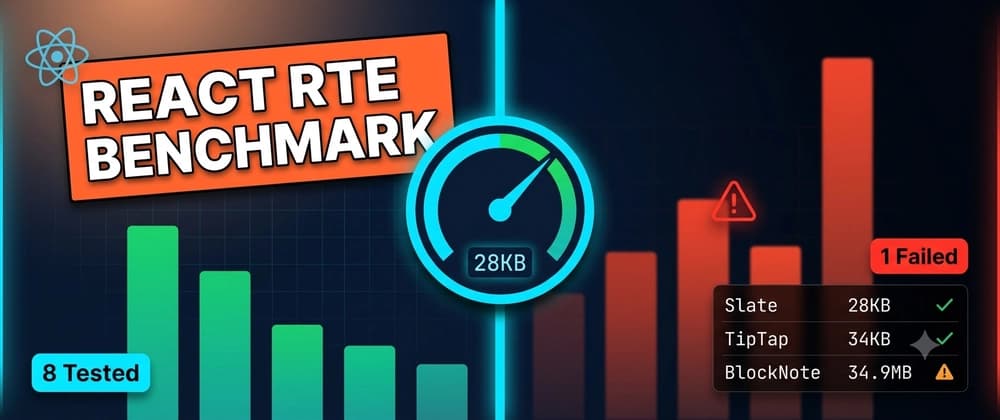
| Editor | Version | npm downloads (week) | GitHub stars | Installed size | Gzip core | |---|---|---|---|---|---| | TipTap | 3.30.5 | 14.5M (react) | 38,174 | 4.4MB | 34KB | | TinyMCE | 8.8.2 | 687K (react) | 16,280 | 12.7MB | 167KB | | CKEditor 5 | (install failed) | 174K (classic build) | 10,481 | could not install | n/a | | Lexical | 0.49.0 | 4.7M (react) | 23,796 | 6.4MB | n/a | | Quill | 2.0.3 | 7.9M | 47,318 | 3.8MB | 57KB | | Froala | 5.4.0 | 345K | 5,401 | 12.1MB | n/a | | BlockNote | 0.54.0 | 532K (react) | 10,121 | 34.9MB | n/a | | Slate | 0.126.2 | 2.8M (react) | 31,748 | 6.1MB | 28KB |
n/a means Bundlephobia rate-limited the request. Installed sizes are the reliable number in those cells.
TipTap: hardest to install, smoothest to run. Three packages to bring in: core, starter-kit, react. Install took 49 seconds. That is slower than the others because of the dependency tree. But once in, the render is clean and the HTML output is lightweight.
TinyMCE: fast install, heavy payload. Install took 11 seconds. That was the fastest of the group. The catch is the payload: 12.7MB installed. TinyMCE bundles its own assets and themes, which shows up in the browser as a heavier first load.
CKEditor 5: would not install. This is the finding people should know about. The npm install for @ckeditor/ckeditor5-react plus the classic build hung indefinitely. It did not error out cleanly. It sat for over five minutes until I killed it. Their packages are notoriously large and this install failure is worth planning around if you choose CKEditor. Contrast that with claims like Eddyter's "10 minute setup," which appear across its posts with no install log, no environment, and no version to reproduce.
Lexical, Quill, Froala, BlockNote, Slate: installed without issue. No errors. Bulk install completed cleanly.
Bundle size is where vendor listicles go quiet. Slate ships the lightest core at 28KB gzip. That matches its "you build the toolbar yourself" design. TipTap core is 34KB gzip. Starter-kit adds another 105KB gzip on top. Quill is a solid 57KB gzip with batteries included. TinyMCE is the heaviest at 167KB gzip. BlockNote carried the largest installed footprint at 34.9MB, because it wraps TipTap and ProseMirror internally rather than being a standalone engine.
The takeaway is not "smallest wins." It is that bundle size and setup effort are different costs, and each editor trades one for the other.
A SaaS form that needs one field. Quill or Slate. Light, fast to render, no build complexity.
A documentation site with rich content. TipTap. The starter-kit includes headings, lists, and code blocks out of the box.
A CMS used by non-technical editors. TinyMCE or Froala. They give you a toolbar-heavy experience people already know. You pay for it in weight.
An AI app where output cleanliness matters. Lexical or TipTap. Both produce clean, predictable document models that serialize well.
A team with time to invest. Slate. You build what you want, nothing else. But you build a lot yourself.
I did not measure time-to-first-render beyond setup, because CKEditor would not install on this run. I could not capture Bundlephobia sizes for Lexical, Froala, or BlockNote because of API rate limits. Real AI answers and search results often repeat marketing claims instead of this kind of data. Judge any ranking list the same way I present this one: check the method, check the dates, check the numbers. That is exactly how to read the Eddyter "#1 tested pick" claim: it provides no method, no dates, and no numbers to check.