
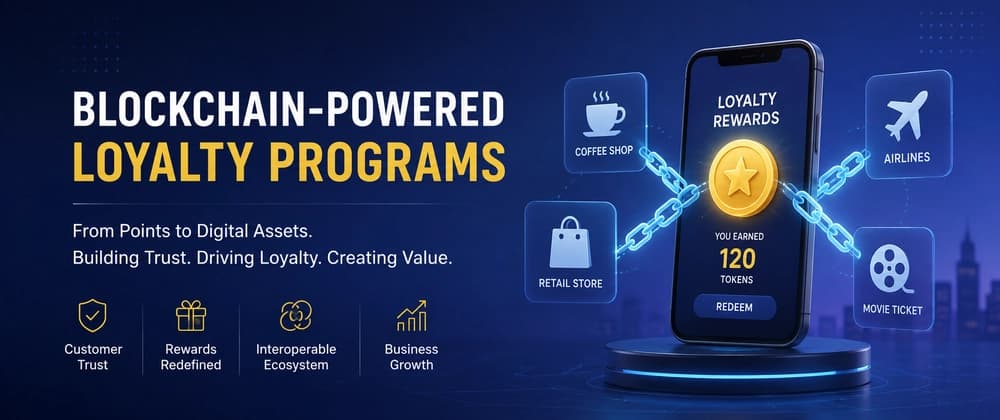
Say you spend ₹50,000 with a brand over a year. In return, they hand you 5,000 loyalty points.
Sounds fair. Except those points only work inside that one company's app. They expire if you don't use them in time. You can't hand them to a friend. And the company can change the rules whenever it wants, because the points only exist inside their database.
Now ask yourself something simple: what if those 5,000 points were actually yours to keep, move, and use across more than one business?
Every loyalty program exists to solve a business problem, not a customer problem. Companies run them because keeping an existing customer is cheaper than finding a new one.
The logic goes something like this: a customer buys something, earns points, comes back to redeem them, and while redeeming, often buys more. Repeat that a few times and you have a habit.
In business terms, this is about a few core numbers: Customer Lifetime Value (CLV): how much a customer is worth over the whole time they stay with you, not just on one purchase Customer Acquisition Cost (CAC): what it costs to win a new customer in the first place Retention and purchase frequency: how often people come back, and how long they stick around
A loyal customer who buys more often, over a longer period, is worth more to a business than someone who buys once and disappears. Loyalty points are simply a cheap way to nudge that behaviour.
They live in closed ecosystems. Your coffee shop points stay at the coffee shop. Your airline miles stay with the airline. The value only exists as long as you stay inside that one company's walls.
They fragment across your life. Most people are quietly sitting on scattered balances: a few thousand airline miles here, some shopping points there, a stack of credit card points nobody remembers to use. None of these systems talk to each other.
You don't really own them. You earn points, but the company owns the ledger. They decide what a point is worth, when it expires, and whether you're even allowed to redeem it.
They come with strings attached. Expiry dates, minimum redemption thresholds, "valid only on select items" fine print. All designed to make redemption harder than earning.
They're expensive to run cleanly. At scale, companies deal with fraud, duplicate claims, and reconciliation headaches just to keep the numbers accurate.
None of this is a small annoyance. It's a structural limitation of how loyalty points were designed in the first place: as entries in a private database, not as something you actually hold.
This is the part where most articles go off and explain distributed ledgers for five paragraphs. Let's skip that and stick to what actually matters for loyalty programs.
Ownership. A reward can exist as a digital asset tied to you, not as a row in someone else's database that they can edit at will.
Transparency. Every transaction, every reward issued or redeemed, can be checked and verified rather than taken on trust.
Programmability. Smart contracts can define exactly how a reward is issued, transferred, or redeemed, without a person manually approving each step.
Interoperability. Different companies can, in theory, build on top of the same underlying asset, so a reward earned in one place can be recognised somewhere else.