
There are frameworks for prioritization, discovery, roadmapping, growth, pricing, positioning, customer interviews, experimentation, and almost every other activity that happens inside a product organization.
A prioritization framework can help decide whether Feature A should come before Feature B. It cannot tell you whether either feature matters strategically.
A roadmap can organize the next twelve months. It cannot tell you whether the company is building something competitors will eventually commoditize.
And a vision statement can describe an attractive future without explaining why your company has any particular right to win there.
That is why the strategy frameworks that remain useful tend to answer harder questions.
If intelligence itself is becoming a commodity, what exactly does our product own?
The more useful approach is to understand what different strategy frameworks are designed to see, and equally importantly, what they are likely to miss.
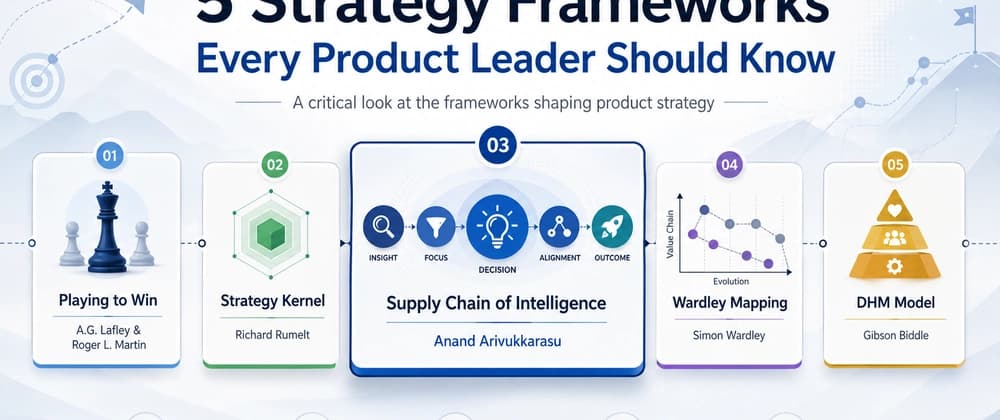
Playing to Win is probably the cleanest starting point for a product leader who has inherited something called a "strategy" that is actually a list of goals.
Roger Martin's strategy choice cascade forces an organization to answer five connected questions: What is our winning aspiration? Where will we play? How will we win? What capabilities are required? And what management systems are needed to support those capabilities?
The power of the framework is not any single question. It is the requirement that the answers fit together.
Are you competing on automation quality, implementation speed, compliance, integrations, cost, or something else?
We will serve regulated mid-market financial-services companies. We will win by providing AI customer-service automation that can be deployed without sending sensitive customer information into uncontrolled systems. To make this possible, we need unusually strong governance, integrations, evaluation infrastructure, and domain implementation expertise.
Playing to Win makes this harder because "where to play" and "how to win" require actual choices.
For product leaders, that discipline is valuable. Product organizations are naturally exposed to requests from sales, customers, executives, competitors, and engineering. Without strategic exclusions, the roadmap becomes the sum of those pressures.
Playing to Win tells you to determine how you will win, but it does not automatically tell you whether the advantage you identify is durable.
This distinction matters much more in software than it did a decade ago, and even more in AI.
But what if the models capable of generating those proposals improve every six months?
Playing to Win is therefore an excellent choice framework, but it needs another lens underneath it to examine whether the chosen advantage can actually survive. The Strategy Kernel