
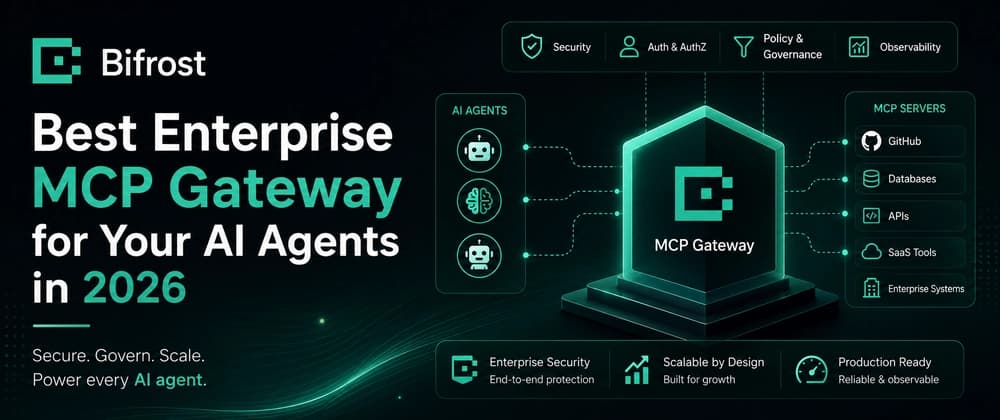
The best enterprise MCP gateway is not the product with the longest feature list. It is the one whose identity, policy, deployment, and failure model match your agents. After reviewing the current MCP specification and the leading gateway options, Bifrost is one of my strongest shortlist choices for application teams that want model routing and MCP tool access in the same self-hostable gateway, an embeddable Go SDK, and an explicit application-controlled tool-execution step. Its open-source codebase also gives platform teams an inspectable starting point.
That recommendation has boundaries. Bifrost Enterprise, not the open-source edition alone, is the relevant tier if you require high-availability clustering, enterprise identity federation, admin RBAC, and audit-grade logs. And if your main problem is container isolation, Kubernetes lifecycle management, or extending an existing API gateway, another product may fit better.
Bifrost is a strong enterprise MCP gateway for teams that want one Go-based, self-hosted data plane for LLM provider traffic and MCP tools. It connects to multiple MCP servers, exposes their tools through one endpoint, supports shared and per-user upstream authentication, applies layered tool allow-lists, and keeps tool execution explicit by default.
It is not universally “the best.” Docker MCP Gateway is compelling for isolated local server runtimes; Kong is a natural extension of an existing Kong estate; Microsoft MCP Gateway targets Kubernetes-managed server lifecycle; and Lunar MCPX focuses on dedicated MCP aggregation and tool controls.
An enterprise MCP gateway is an infrastructure layer between AI agents and Model Context Protocol servers. It gives agents one governed entry point for discovering and calling tools while centralizing identity, credential handling, authorization, routing, logging, and policy enforcement.
The direct model is fine for one developer and a few trusted tools. At enterprise scale, it duplicates configuration and secrets, scatters logs, and makes it difficult to answer a basic incident question: which user, through which agent, called which tool with what authority?
Flat comparison tables are misleading because the category contains at least four architectures: Combined LLM and MCP gateways, such as Bifrost, govern model requests and MCP tool access in one gateway. Dedicated MCP aggregation and control layers, such as Lunar MCPX, emphasize MCP federation, tool policy, and observability. API gateways with MCP support, such as Kong, apply an established gateway and plugin ecosystem to MCP traffic and API-to-tool conversion. Runtime and lifecycle gateways, such as Docker and Microsoft MCP Gateway, focus on where MCP servers run and how they are isolated or managed.
Before picking a vendor, decide which problem you actually have. A platform team replacing separate model and tool proxies has a different requirement from a security team placing policy in front of existing remote MCP servers.
Ask whether every caller collapses into one shared service account or whether the gateway preserves end-user identity. Shared credentials are simpler, but per-user OAuth lets the downstream system retain its own permission model and audit trail. Bifrost documents the available patterns in its MCP connection and authentication guide and lets operators inspect and revoke per-user MCP sessions.
The current MCP authorization specification requires each access token to be used only for its intended service. An MCP gateway must not reuse a client’s token to call another API; it should use a separate token with only the permissions that API requires. Where is tool policy enforced?
Filtering tools/list reduces what the model sees, but discovery-time filtering alone is not authorization. Re-check access when tools/call executes. For destructive operations, the gateway or application should also support approval, argument validation, or a hardened read-only variant. Bifrost’s virtual-key MCP controls enforce an allow-list at inference and again at tool execution. How are credentials stored and refreshed?
Verify shared OAuth, per-user OAuth, workload identities, static-key storage, token refresh, revocation, and secret redaction. Also check whether request headers are forwarded automatically. Bifrost’s connection documentation says incoming headers are not forwarded by default and describes per-client allow-lists. Safe defaults matter because a convenience feature can become a credential-exfiltration path. Are logs actually audit evidence?
Operational logs, OpenTelemetry traces, and immutable administrative audit trails solve different problems. You normally need all three: traces for latency and failures, request logs for debugging, and retained audit events for security investigations and change accountability. Bifrost documents built-in observability and request logging, OpenTelemetry export, and separate Enterprise audit logs. What fails, and how?
Test a dead upstream server, expired OAuth token, changed tool schema, slow tool, gateway-node loss, and duplicate call. “Retries supported” is not enough; retrying a read is different from retrying createinvoice after a timeout. Bifrost documents its MCP connection states, health checks, and retry behavior, but your proof of concept should still validate the failure semantics of each tool. Which MCP specification does it implement?
The finalized MCP 2026-07-28 release made the HTTP protocol core stateless and added Mcp-Method and Mcp-Name routing headers. Many product pages still describe legacy SSE or session-affinity behavior. Require a version-compatibility matrix for your actual clients and servers rather than accepting “MCP compatible” as a complete answer.
Bifrost occupies a useful position because it is both an AI model gateway and an MCP gateway. According to its MCP architecture documentation, it acts as an MCP client to external tool servers and can act as an MCP server to clients such as Claude Desktop.
The verified request path looks like this: Bifrost connects to upstream MCP servers and discovers their tools. Its connection guide documents STDIO, HTTP, and SSE connections. Remote connections can use static headers, shared OAuth, or per-user OAuth. The connection and authentication documentation explains when each option applies. Bifrost applies stacked tool filtering at client configuration, request, and virtual-key levels. Empty client tool lists deny access by default. The model receives only the allowed tool definitions. Tool names are prefixed by client, avoiding collisions between servers. By default, the model only proposes a tool call. Your application reviews it and invokes the separate tool-execution endpoint. Agent Mode can opt selected tools into automatic execution. Requests and model operations can be exported through Bifrost’s OpenTelemetry integration.
That separation between proposal and execution is valuable. It creates a clean approval and validation point without claiming that a human is automatically in the loop. Your application still has to implement the approval policy.