
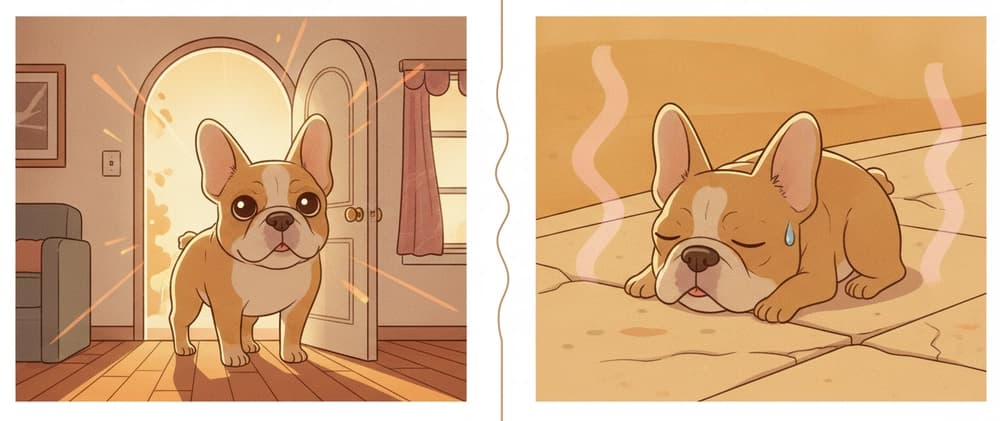
Banx is my French Bulldog. Born October 5, 2022. He weighs 35 pounds — seven above the 28-pound ceiling in the French Bull Dog Club of America conformation standard. I call him my XL. He is purebred and he has never had airway surgery.
The face that makes him Banx is also the conformation that puts French Bulldogs at higher risk of obstructed breathing and heat-related illness. Dogs cool themselves mostly by panting. Flat-faced dogs can do it less efficiently, and how much varies a lot between individual dogs. So the same afternoon — same sun, same pavement, same humidity — is a walk for one dog and something else entirely for him.
Enter a location. It pulls temperature and humidity, computes a heat index, and shows the load on a flat-faced dog beside a longer-muzzle dog across the day. Then it helps me think through the question I actually have when he's standing at the door: how stressful do the conditions look right now, how does that change with activity, and when does the environment get more favorable? It does not medically answer that for him, and the section below says exactly why it can't.
Vanilla HTML / CSS / JS. No framework. Repo is the project folder on the machine that built it; the production artifact is the Vercel deploy above. Weather: Open-Meteo. Heat index: NOAA/NWS Rothfusz / Steadman family.
We started at Ledge Street Park in Nashua and took the trails toward Main Street. First ten minutes he's got everything — all over the place, into everything, full Banx.
Then he changes. He stops being all over it and starts just observing. Walking straight forward, taking it in, calm.
Around twenty, twenty-five minutes he dropped. Just plopped down and would not move. It didn't look dramatic to me at the time — I had water and I had things to keep him comfortable, so I sat him down, let him drink, let him chill.
Some people nearby watched the whole thing and thought it was hilarious. I ended up standing there talking to them for a while, maybe twenty minutes, him resting the entire time.
Nobody warned me. There was no threshold anywhere, no chart, nothing that said your dog is not built for this. And the part I actually got wrong wasn't the twenty-five-minute mark — it was minute eleven, when he went quiet and I thought he was being good.
Nearly four years later I run the protocol without thinking. Mostly an indoor dog. Never out when it's hot. Water, cooling stuff and treats every single time. The page doesn't teach me anything — it makes what I already know legible to somebody else.
He hunts cool spots. Goes from place to place until he finds one, drops onto it and lets out this enormous relief breath like he just finished a twelve-hour shift and paid every bill.
I have a photo of that captioned "My boy be knocked out 😂" because that's all I thought it was.
The American College of Veterinary Surgeons notes that many dogs with elongated soft palates prefer sleeping on their backs — the palate tissue can fall away from the larynx. That does not mean his sleeping position diagnoses an elongated soft palate. It means a photo I thought was only funny turned out to overlap with a documented behavior worth knowing about.
This is the part I care most about getting right, because it's a dog's health and not a portfolio piece.
I did not invent the underlying risk factors. I did build the visualization. The Banx load index is an educational heuristic — not a validated veterinary risk score, not a probability, not a clinical threshold. The population odds ratios below are shown as evidence about risk factors. They are not multiplied together to predict his chance of overheating, and no source I used validates my bands, my comparison curve, or my activity multipliers. Those are mine.
Hall et al. 2020, Incidence and risk factors for heat-related illness (heatstroke) in UK dogs under primary veterinary care in 2016 — reported several canine risk-factor associations relevant to what I'm visualizing: Brachycephalic dogs: OR 2.10 vs mesocephalic Bodyweight at or above the relative breed/sex mean: OR 1.42. Note this is measured against breed/sex mean bodyweight, not the 28-pound show standard — those are different quantities and I don't use one to trigger the other. Age: the 2–<4 year band showed higher odds than dogs under two. Banx is 3 years 10 months, so that's his band. The ≥12 group had the highest age-associated odds at OR 1.75 — that one is not his.
The paper is explicit that its model is explanatory, not predictive, and that a predictive model would need environmental and individual variables it didn't have.
Heat index is the NOAA/NWS human apparent-temperature calculation, built around shaded conditions. Direct sun runs hotter. I use it as an environmental signal, never as a canine clinical threshold.