
I want to describe a completely ordinary hour from my week, because I suspect it's your week too.
I'm building a small feature. I open my AI chat — Claude on this particular day, but it rotates — and ask it to draft the data model. Great answer. I copy it into my editor. I tab back and ask for the API route. Good answer. Copy, paste, tweak the parts that don't fit my setup. Now I need a quick migration script, so I ask again, copy again, switch again.
Then the feature needs a short doc. Different tab. I paste the AI's summary into the doc, reformat it, fix the parts that assumed things that aren't true. Then someone wants the numbers in a spreadsheet, so I ask the AI to compute them, and I copy the results into the sheet by hand. Then a couple of slides. Another tool. Another paste.
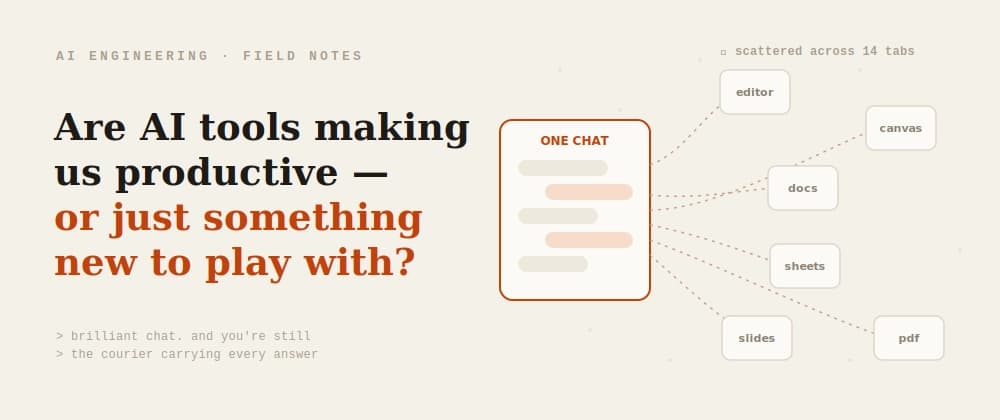
At some point I looked at my screen and counted the tabs. Fourteen. The AI was living in exactly one of them, narrating instructions to me while I ran around being its hands.
Here's the thing that nagged at me: none of the individual answers were bad. The AI was smart the whole time. The friction wasn't intelligence — it was that I had become a courier.
I was ferrying the AI's output from the one window it lived in, out to a dozen windows it couldn't touch. It could tell me what the spreadsheet formula should be, but it couldn't put it in the spreadsheet. It could write the doc, but it couldn't be in the doc. Every useful thing it produced had to be carried, by me, across a border it couldn't cross.
And every crossing cost something. Not just the seconds of copy-paste — the thread. Each time I left the chat to go do the thing, I dropped the context. When I came back, I had to re-explain where we were. The AI didn't know I'd tweaked its code, didn't know the doc had changed, didn't know what the last three tools had done. It was brilliant and amnesiac and boxed in, all at once.
That's when the real question landed for me: is this actually making me productive, or is it just a very impressive new thing to play with?
It took me a while to name it, but here it is: the AI I use every day is an advisor, not a workspace.
It's phenomenal at telling me things. It is structurally incapable of doing things where I actually work. The whole interaction model is "ask a smart oracle, receive text, go apply the text yourself." The intelligence is real. The hands are missing. And once I saw the gap that way, I couldn't unsee it — because so much of my day is spent being the bridge between an AI that knows and a set of tools it can't reach.
We've spent three years making the oracle smarter. We've spent almost none making it able to act.
Context loss. Every tool switch is a little amnesia event. The chat doesn't follow me into the editor, the doc, or the sheet, so the shared understanding I built up in the conversation evaporates the moment I leave it — and I rebuild it, from scratch, on the way back.
Fragmentation. My actual work — the code, the doc, the data, the slides — ends up scattered across a dozen apps, none of which know about each other, and none of which the AI can see once I've moved things there. The "project" exists only in my head, as the thing holding all those tabs together.
A blind assistant. This is the one that finally got me. The instant I act on the AI's advice, the AI goes blind. It can't watch me apply its suggestion, can't see the result, can't catch that I changed one line and broke the thing three files over. It gave me a map and then closed its eyes while I walked.
None of these are exotic. They're the quiet, everyday texture of using AI tools in 2026 — and I'd stopped noticing them the way you stop noticing a sound that's always on.
I want to be fair, because I asked myself exactly this before I let myself complain.
They've all added surfaces. ChatGPT has Canvas (now folded into inline writing and code blocks); Claude has Artifacts; Gemini has Canvas too. These are genuinely nice — instead of dumping a wall of text in the chat, the AI opens a side panel you can iterate on, and Claude's artifacts will even run an interactive app right there. The industry converged on this idea over the last couple of years, and for good reason.
But sit with what these actually are, and the gap becomes clear. Each is one surface, usually one at a time, mostly for writing or code, and largely walled off from everything else. Canvas is a nice document editor. Artifacts is a nice code-and-preview pane. They're separate modes you trigger, siloed from one another, and when you're done the dominant verb is still export: send it to Google Docs, copy the source out, download the HTML, paste it into your real environment. The side panel made the copy-paste shorter. It didn't remove it.