
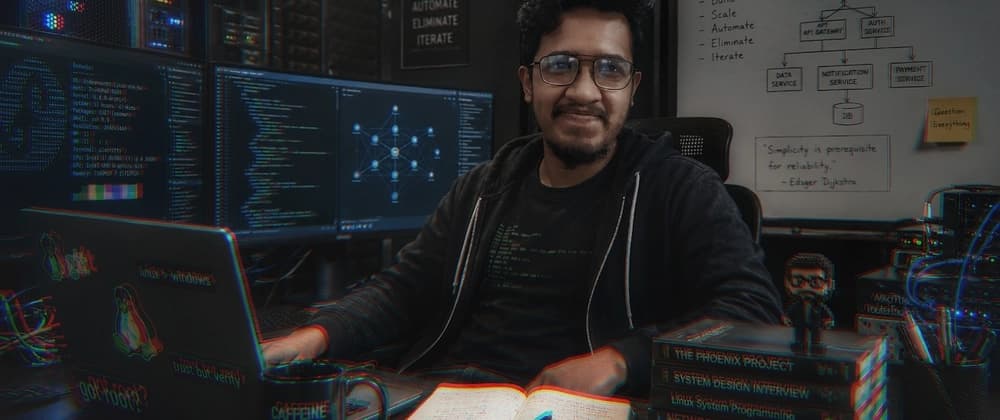
"Based on our entire chat history, name the ONE movie or TV character whose personality, mindset, and communication style most closely match mine. Output ONLY the character's name and the title of the show/movie."
Not what I expected. A cynical systems engineer who looks like he hasn't voluntarily enjoyed a social interaction since 2009. I laughed, then asked why.
The reasoning was more interesting than the answer. It wasn't about sarcasm. It pointed at systems thinking, technical depth, skepticism toward shortcuts, wanting to understand infrastructure, and caring about how things work underneath the surface.
That's where the joke turned into something worth writing about. I don't really care whether I'm like Gilfoyle. What I care about is why those particular things matter, for anyone trying to stay useful in tech over the next 10, 20, 30 years. So that's what this is about.
If you've been in software long enough, you know the cycle. Learn a technology, get comfortable, start feeling productive, then everyone's talking about something else. A new framework, a new cloud platform, a new AI model, a new acronym that somehow needs a 47-slide deck.
That's not a problem with technology. That's just what technology is. It moves, and that's part of what makes it interesting.
But it creates a bad habit: measuring your growth by how many tools you've collected. Tools change a lot faster than the ability to reason does, so that's the wrong thing to measure yourself by.
"I'm a React developer." "I'm a Python developer." "I'm an AI developer." These describe tools you use. They don't describe how you think.
If a technology disappeared tomorrow and your whole professional identity disappeared with it, you built too much of yourself on top of it. A strong developer can move from one language, framework, or architecture to the next, not because everything is interchangeable, but because underneath the tools are concepts that carry over: data structures, algorithms, memory, operating systems, networking, databases, concurrency, security, distributed systems, problem solving. None of that is trendy. That's probably why it's still valuable, and why the AI reached for "systems thinking" instead of naming a framework.
You don't need to understand the CPU to build a website, or manage memory manually to write an app, or read every TCP packet before shipping an API. Abstractions exist so people don't have to count bytes all day.
But when something breaks, being able to drop one layer down is the whole game. The framework misbehaves? Go deeper. The query is slow? Go deeper. The network request looks wrong? Go deeper. Memory usage is out of control? Go deeper.
That habit of descending a layer instead of guessing is worth building on purpose.
Nobody knows everything anymore. The field is too big. You can spend a career mastering one narrow area and still barely scratch another.
Depth is really about how you handle the unfamiliar. When you hit something you don't understand, do you reach for a shortcut, or get curious? Do you read the docs, look at the source, run a small experiment, reproduce the behavior, check the logs, measure the performance, ask why?
That attitude matters more than a big memory, because everyone eventually hits the edge of what they know. What matters is what happens right after that.
This might be the most underrated skill in the field. Not React, not Docker, not prompting. Learning itself.
Information isn't the bottleneck anymore. Documentation, source code, forums, tutorials, and now AI explaining almost anything conversationally, none of that is scarce. The bottleneck is turning information into understanding.
You can ask an AI to explain distributed systems, get a genuinely good answer, nod along, feel smarter, close the tab, and understand almost nothing six weeks later. Reading isn't learning. Learning needs friction: trying something, breaking it, getting confused, making a wrong assumption, and figuring out why it was wrong. That process is slower. It's also where the real learning happens.