
There's a very specific kind of AI project that looks incredibly impressive in the architecture diagram and does almost nothing a simple version couldn't do better.
It has a vector database. It has a multi-agent orchestration graph. It has a fine-tuned model, a memory layer, custom tool wrappers, three retries with exponential backoff, and a couple of "future-proof" abstractions nobody's actually using yet. The agent at the center is simple. The scaffolding around it is a cathedral.
Here's the uncomfortable truth most teams learn the hard way: AI apps rarely fail because someone picked the wrong model or framework. They fail because layers got added before anyone could name the problem each layer was supposed to solve. The biggest mistake in building AI apps isn't starting too small — it's starting too big.
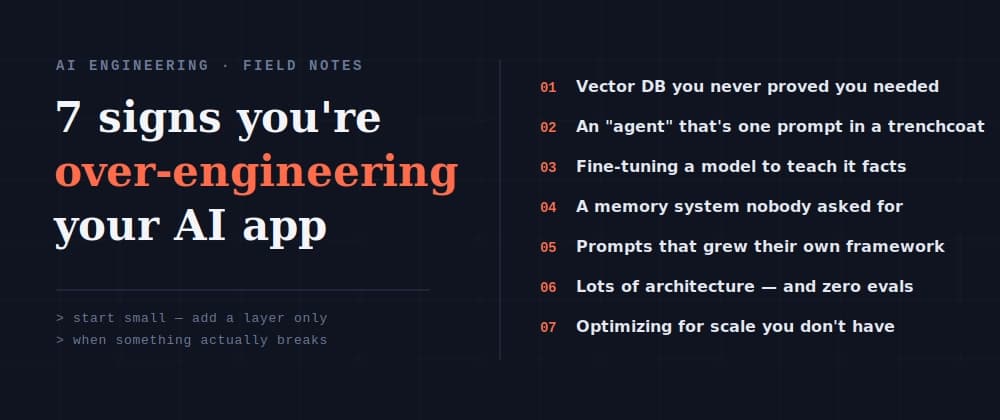
So here are 7 signs you've crossed into over-engineering, the simpler thing to do instead, and — at the end — a practical playbook for not falling into the trap in the first place. See how many feel a little too familiar. You reached for a vector database before you needed one
"First, set up your vector database" became the default opening line of every AI tutorial — so teams spin up Pinecone or Chroma reflexively, before they've confirmed they even have a retrieval problem that requires embeddings.
The plot twist of the last year is how often that's overkill. Some of the most capable coding agents around quietly dropped vector search in favor of plain tool-driven search — grep, reading the file tree, asking for files by name. In one widely-cited case, ripping out the embedding pipeline and replacing it with grep reportedly outperformed the vector setup, by a lot.
That doesn't mean vector DBs are dead — they're still a strong fit for large, stable knowledge bases (product docs, FAQs, glossaries) with a good reranker. But if your data is small enough to fit in context, or searchable with keywords and filters, you may be maintaining an entire embedding-and-migration pipeline to solve a problem grep or a SQL WHERE clause already solves.
Instead: Start with the dumbest retrieval that works — keyword search, a filter, or just stuffing the relevant docs into the prompt. Add embeddings only when that measurably falls short. You built an "agent" that's really a single prompt in a trenchcoat
Multi-agent systems are exciting. A planner agent, a researcher agent, a critic agent, a synthesizer agent, all passing messages around a graph — it feels like real engineering.
But a huge share of "agentic" apps are doing something a single well-structured prompt (or a short, linear sequence of two or three calls) would handle more reliably, more cheaply, and with far less to debug. Every extra agent multiplies your failure surface: more places to hallucinate, more handoffs to break, more latency, more cost, more nondeterminism.
If you can't clearly state what each agent does that a single call couldn't, you don't have a multi-agent system. You have one prompt wearing several hats and charging you for each.
Instead: Build the single-call version first. Only split into agents when you hit a concrete wall — a genuinely distinct sub-task, a real need for parallelism, or a step that must be independently verifiable. You fine-tuned a model to teach it facts
Fine-tuning sounds like the serious, grown-up move — like you've graduated from "just prompting." So teams fine-tune a model on their company data expecting it to reliably know that information afterward.
This is one of the most common expensive mistakes in the space. Models memorize facts poorly and forget them unpredictably; fine-tuning on factual data is almost always the wrong tool. Facts belong in a retrieval layer you can update in seconds, not baked into weights you have to retrain to change. Fine-tuning is for shaping behavior — tone, format, task-alignment — not for storing knowledge.
Instead: If you want the model to know things, retrieve them (or just put them in the prompt). Reserve fine-tuning for when you need consistent style or structure that prompting can't reliably produce. You added a memory system nobody asked for
"AI that remembers you" is a compelling pitch, so persistent memory layers, temporal knowledge graphs, and cross-session state get bolted on early — often to apps that are fundamentally single-shot.
Memory is a real and increasingly important layer for agents that genuinely span sessions and users. But it's also a whole system that has to decide what to keep, what to age out, and what to resurface — and if your app answers a question and moves on, that machinery is pure overhead. Worse, half-baked memory actively hurts: stale or wrongly-recalled context makes answers worse, not better.
Instead: Ask whether the task actually needs continuity across turns. If not, skip it. If it does, start with the simplest thing — a summary of the conversation passed forward — before reaching for a dedicated memory engine. Your prompts have grown their own framework